Question
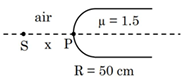
Light from a point source in air falls on a spherical glass surface (refractive index, $\mu=1.5$ and radius of curvature $=50 \mathrm{~cm}$ ). The image is formed at a distance of 200 cm from the glass surface inside the glass. The magnitude of distance of the light source from the glass surface is __________ m.
Answer

4
Image
$\frac{\mu_{2}}{v}-\frac{\mu_{1}}{\mathrm{u}}=\frac{\mu_{2}-\mu_{1}}{\mathrm{R}}$
$\frac{1.5}{200}-\frac{1}{-\mathrm{x}}=\frac{1.5-1}{50}$
$\frac{1}{x}=\frac{1}{100}-\frac{3}{400}$
$\mathrm{x}=400 \mathrm{~cm}$
$\mathrm{x}=4 \mathrm{~m}$

Need a full question paper?

Generate a complete, print-ready paper with questions like this in minutes — across 16+ boards, with answer keys.

Start Generating Free

Similar questions

A mass of $5\, {kg}$ is connected to a spring. The potential energy curve of the simple harmonic motion executed by the system is shown in the figure. A simple pendulum of length $4\, {m}$ has the same period of oscillation as the spring system. What is the value of acceleration due to gravity on the planet where these experiments are performed? (In ${m} / {s}^{2}$)
Fountains usually seen in gardens are generated by a wide pipe with an enclosure at one end having many small holes. Consider one such fountain which is produced by a pipe of internal diameter $2$ $cm$ in which water flows at a rate $3$ $ms^{^{-1}}$. The enclosure has $100$ holes each of diameter $0.05$ $cm$. The velocity of water coming out of the holes ids ( in $ms^{^{-1}}$) 
A series combination of two resistors $1\,\Omega $ each is connected to a $12\,V$ battery of internal resistance $0.4\,\Omega $. The current flowing through it will be ............... $A$
A ball of mass $( m )=0.5 \ kg$ is attached to the end of a string having length $(L)$ $=0.5 m$. The ball is rotated on a horizontal circular path about vertical axis. The maximum tension that the string can bear is $324 \ N$. The maximum possible value of angular velocity of ball (in radian/s) is
Two blocks $A$ and $B$ of masses $6\, kg$ and $3\, kg$ rest on a smooth horizontal surface as shown in the figure. If coefficient of friction between $A$ and $B$ is $0.4$, the maximum horizontal force which can make them without separation is  ........ $N$ 
Two slits are $1 \mathrm{~mm}$ apart and the screen is located $1 \mathrm{~m}$ away from the slits. A light wavelength $500 \mathrm{~nm}$ is used. The width of each slit to obtain $10$ maxima of the double slit pattern within the central maximum of the single slit pattern is $\ldots \ldots \ldots \times 10^{-4} \mathrm{~m}$
One mole of an ideal monoatomic gas undergoes the following four reversible processes:

Step $1$ It is first compressed adiabatically from volume $V_{1}$ to $1 \;m ^{3}$.

Step $2$ Then expanded isothermally to volume $10 \;m ^{3}$.

Step $3$ Then expanded adiabatically to volume $V _{3}$.

Step $4$ Then compressed isothermally to volume $V_{1}$. If the efficiency of the above cycle is $3 / 4$, then $V_{1}$ is ............ $m^3$

A glass tumbler having inner depth of $17.5\, {cm}$ is kept on a table. A student starts pouring water $(\mu=4 / 3)$ into it while looking at the surface of water from the above. When he feels that the tumbler is half filled, he stops pouring water. Up to what height, the tumbler is actually filled ? (In $cm$)
A metal block is exposed to beams of $X-$ ray of different wavelength. $X-$ rays of which wavelength penetrate most.......$\mathop A\limits^o $
An object of height $1.5 cm $ is placed on the axis of a convex lens of focal length $25 cm.$ A real image is formed at a distance of $75 cm$ from the lens. The size of the image will be........$cm$