Question
Light incident normally on a plane mirror attached to a galvanometer coil retraces backwards. A current in the coil produces a deflection of 3.5° of the mirror. What is the displacement of the reflected spot of light on a screen placed 1.5 m away?
Answer

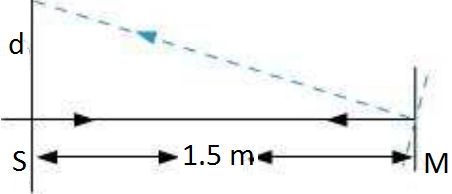
Angle of deflection, θ = 3.5°
Distance of the screen from the mirror, D = 1.5 m
The reflected rays get deflected by an amount twice the angle of deflection i.e., 2θ = 7.0°
The displacement (d) of the reflected spot of light on the screen is given as:
$\tan2\theta=\frac{\text{d}}{1.5}$
$\therefore \ \text{d}=1.5\times\tan7^\circ=0.814 \ \text{m}=18.4 \ \text{cm}$
Hence, the displacement of the reflected spot of light is 18.4 cm.

Need a full question paper?

Generate a complete, print-ready paper with questions like this in minutes — across 16+ boards, with answer keys.

Start Generating Free

Similar questions

Water flows through a horizontal tube of variable cross-section. The area of cross-section at A and B are 4mm2 and 2mm2 respectively. If 1cc of water enters per second through A, find,
  1. The speed ofwater at A.
  2. The speed of water at B.
  3. Thepressure difference PA - PB.

Two monochromatic rays of light are incident normally on the face AB of an isosceles right-angled prism ABC. The refractive indices of the glass prism for the two rays ‘1’ and ‘2’ are respectively 1.38 and 1.52. Trace the path of these rays after entering through the prism.

State factors on which the resistance of a conductor depends.
Suppose the energy liberated in the recombination of a hole-electron pair is converted into electromagnetic radiation. If the maximum wavelength emitted is 820nm, what is the band gap?
In a long straight wire, a current of 5 A is flowing. How much magnetic field will be produced at a distance of 10 cm from it? Which rule will give the direction of the field?
What is point electric charge?
You are riding in a car. The driver suddenly applies the brakes and you are pushed forward. Who pushed you forward?
Calculate the energy in fusion reaction:
$^{2}_{1}\text{H} + ^{2}_{1}\text{H}\rightarrow^{3}_{2}\text{H}+ \text{n}, \text{where BE}\text{ of} ^{ 2}_{1}\text{H} = 2.23 \text{MeV} \text{and} \text{of} ^{3}_{2}\text{He} = 7.73 \text{MeV}.$
The fission properties of ${ }_{94}^{239} Pu$ are very similar to those of ${ }_{92}^{235} U$. The average energy released per fission is 180 MeV . How much energy, in MeV, is released if all the atoms in 1 kg of pure ${ }_{94}^{239} Pu$ undergo fission?
Differentiate between electric lines of force and magnetic lines of force.