MCQ
light is incident normally on a diffraction grating through which the first order diffraction is seen at $32.$ The second order diffraction will be seen at
  • A
    $ 48$
  • B
    $ 64$
  • C
    $80$
  • There is no second order diffraction in this case

Answer

Correct option: D.
There is no second order diffraction in this case
For a grating, $(e+d) \sin \theta_n=n \lambda$
where $(e+d)=$ greating element
$\sin \theta_n=\frac{n \lambda}{(e+d)}$
For $n=1, \sin \theta_1=\frac{\lambda}{(e+d)}=\sin 32^{\circ}$
This is more than 0.5 . Now $\sin \theta_2$ will be more than $2 \times 0.5$, which is not possible.

Need a full question paper?

Generate a complete, print-ready paper with questions like this in minutes — across 16+ boards, with answer keys.
Start Generating Free

Similar questions

A ray of light falls on the surface of a spherical glass paper weight making an angle $\alpha$ with the normal and is refracted in the medium at an angle $\beta$. The angle of deviation of the emergent ray from the direction of the incident ray
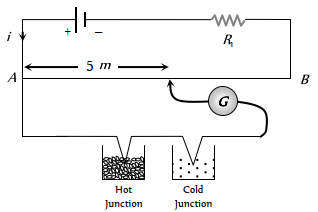
In the following circuit a $10 \mathrm{~m}$ long potentiometer wire with resistance $1.2 \mathrm{ohm} / \mathrm{m}$, a resistance $R$ and an accumulator of emf $2 \mathrm{~V}$ are connected in series. When the emf of thermocouple is $2.4 \mathrm{mV}$ then the deflection in galvanometer is zero. The current supplied by the accumulator will be

Image

The minimum intensity of light to be detected by human eye is $10^{-10} \mathrm{~W} / \mathrm{m}^2$. The number of photons of wavelength $5.6 \times 10^{-7} \mathrm{~m}$ entering the eye, with pupil area $10^{-6} \mathrm{~m}^2$, per second for vision will be nearly
A potentiometer consists of a wire of length $4 \mathrm{~m}$ and resistance $10\ \Omega$. It is connected to cell of emf $2\ V$. The potential difference per unit length of the wire will be
The graph between $\sqrt{E}$ and $\frac{1}{p}$ is $(E=$ kinetic energy and $p=$ momentum)
A ray incident a $15^{\circ}$ on one refracting surface of a prism of angle $60^{\circ}$, suffers a deviation of $55^{\circ}$. What is the angle of emergence
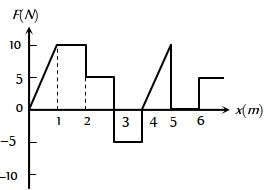
The relationship between the force $F$ and position $x$ of a body is as shown in figure. The work done in displacing the body from $x=1 \mathrm{~m}$ to $x=5 m$ will be

Image

A lorry and a car moving with the same K.E. are brought to rest by applying the same retarding force, then
If the focal length of objective and eye lens are $1.2 \mathrm{~cm}$ and $3 \mathrm{~cm}$ respectively and the object is put $1.25 \mathrm{~cm}$ away from the objective lens and the final image is formed at infinity. The magnifying power of the microscope is
A body is imparted motion from rest to move in a straight line. If it is then obstructed by an opposite force, then