MCQ
Light of wavelength $5000\,\,\mathop A\limits^o $ falling on a sensitive surface. If the surface has received $10^{-7}\,J$ of energy, then the number of photons falling on the surface will be
  • A
    $5\times 10^{11}$
  • $2.5\times 10^{11}$
  • C
    $3\times 10^{11}$
  • D
    none of these

Answer

Correct option: B.
$2.5\times 10^{11}$
b
Energy of one photon $=\frac{\mathrm{hc}}{\lambda}=4 \times 10^{-19}=\mathrm{E}$

$(n)$ $(\mathrm{E})=$ Energy $=10^{-7}$

$(n)$ $\left(4 \times 10^{-19}\right)=10^{-7}$

$\mathrm{n}=2.5 \times 10^{11}$

Need a full question paper?

Generate a complete, print-ready paper with questions like this in minutes — across 16+ boards, with answer keys.

Start Generating Free

Similar questions

The equivalent capacitance of three capacitors of capacitance $C_1,C_2$ and $C_3$ are connected in parallel is 12 units and product $C_1 \cdot C_2 \cdot C_3=48$. When the capacitors $C_1$ and $C_2$ are connected in parallel, the equivalent capacitance is 6 units. Then the capacitance are
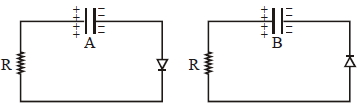
Two identical capacitors $\mathrm{A}$ and $\mathrm{B}$, charged to the same potential $5\; \mathrm{V}$ are connected in two different circuits as shown below at time $\mathrm{t}=0$ If the charge on capacitors $A$ and $B$ at time $\mathrm{t}=\mathrm{CR}$ is $\mathrm{Q}_{\mathrm{A}}$ and $\mathrm{Q}_{\mathrm{B}}$ respectively, then (Here $e$ is the base of natural logarithm)
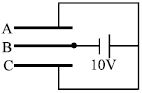
Three plates $A, B$ and $C$ each of area $0.1 \ m^2$ are separated by $0.885\  mm$ from each other as shown in the figure. $A$ $10$ $V$ battery is used to charge the system. The energy stored in the system is
Assertion : The refractive index of diamond is $\sqrt 6$ and that of liquid is $\sqrt 3$ . If the light travels from diamond to the liquid, it will totally reflected when the angle of incidence is $30^o$.

Reason : $\mu  = \frac{1}{{\sin \,C}}$ , where $\mu $ is the refractive index of diamond with respect to liquid

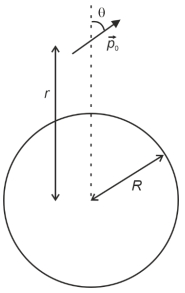
A small electric dipole $\vec{p}_0$, having a moment of inertia I about its center, is kept at a distance $r$ from the center of a spherical shell of radius $R$. The surface charge density $\sigma$ is uniformly distributed on the spherical shell. The dipole is initially oriented at a small angle $\theta$ as shown in the figure. While staying at a distance $r$, the dipole is free to rotate about its center.

If released from rest, then which of the following statement($s$) is (are) correct? [ $\varepsilon_0$ is the permittivity of free space.]

$(A)$ The dipole will undergo small oscillations at any finite value of $r$.

$(B)$ The dipole will undergo small oscillations at any finite value of $r>R$.

$(C)$ The dipole will undergo small oscillations with an angular frequency of $\sqrt{\frac{2 \sigma p_0}{\in_0 I}}$ at $r=2 R$

$(D)$ The dipole will undergo small oscillations with an angular frequency of $\sqrt{\frac{\sigma p_0}{100 \in_0 l}}$ at $r=10 R$
This question has Statement $-1$ and Statement $-2.$ Of the four choices given after the Statements, choose the one that best describes the two Statements.

Statement $-1:$ Short wave transmission is achieved due to the total internal reflection of the $e-m$ wave from an appropriate height in the ionosphere.

Statement $-2:$ Refractive index of a ionosphere is independent of the frequency of $e-m$ waves

If Young's double slit experiment is performed in water:
If ${N_0}$ is the original mass of the substance of half life period ${T_{1/2}} = 5$ years, then the amount of substance left after $15$ years is
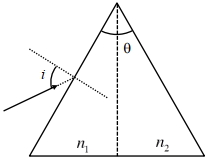
For a prism of prism angle $\theta=60^{\circ}$, the refractive indices of the left half and the right half are, respectively, $n_1$ and $n_2\left(n_2 \geq n_1\right)$ as shown in the figure. The angle of incidence $i$ is chosen such that the incident light rays will have minimum deviation if $n_1=n_2=n=1.5$. For the case of unequal refractive indices, $n_1=n$ and $n_2=n+\Delta n$ (where $\Delta n \ll n$ ), the angle of emergence $e=i+\Delta e$.

Which of the following statement($s$) is (are) correct?

$(A)$ The value of $\Delta e$ (in radians) is greater than that of $\Delta n$

$(B)$ $\Delta e$ is proportional to $\Delta n$

$(C)$ $\Delta e$ lies between 2.0 and 3.0 milliradians, if $\Delta n=2.8 \times 10^{-3}$

$(D)$ $\Delta e$ lies between 1.0 and 1.6 milliradians, if $\Delta n=2.8 \times 10^{-3}$

Nuclear binding energy is equivalent to