Question
Light of wavelength $\lambda$ falls on a metal having work function $\frac{\text{h}_\text{c}}{\lambda_0}.$ Photoelectric effect will take place only if:

  1. $\lambda\geq\lambda_0$

  2. $\lambda\geq2\lambda_0$

  3. $\lambda\leq\lambda_0$

  4. $\lambda<\frac{\lambda_ 0}{2}.$

Answer

  1. $\lambda\leq\lambda_0$

Explanation:

As the work-function of the metal is $\frac{\text{hc}}{\lambda_0}$, its threshold wavelength is $\lambda_0.$

For photoelectric effect, the wavelength of the incident light should be less than or equal to the threshold wavelength of the metal on which light is incident.

Need a full question paper?

Generate a complete, print-ready paper with questions like this in minutes — across 16+ boards, with answer keys.

Start Generating Free

Similar questions

$N( < 100)$ molecules of a gas have velocities $1, 2, 3\,.\,.\,.\,.\,.N/km/s$ respectively. Then
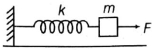
The figure shows a mass $m$ on a frictionless surface. It is connected to rigid wall by the mean of a massless spring of its constant $k$. Initially, the spring is at its natural position. If a force of constant magnitude starts acting on the block towards right, then the speed of the block when the deformation in spring is $x,$ will be
What is the depth at which the value of acceleration due to gravity becomes $\frac{1}{n}$ times the value that at the surface of earth? (radius of earth $=R$ )
A block of mass $m$ is placed on a smooth horizontal surface. A force making an angle $\theta$ with the horizontal starts acting on the block. The magnitude of the force is constant but its direction with the horizontal changes as $\theta = a+ bs$, where $a$ and $b$ are constants and $s$ is the distance covered by the block. If $|F| = 2mb$, find the velocity of the block as function of the angle $\theta$ .
Let np and ne be the number of holes and conduction electrons in an intrinsic semiconductor.

  1. $\text{n}_\text{p} > \text{n}_\text{e}$

  2. $\text{n}_\text{p} = \text{n}_\text{e}$

  3. $\text{n}_\text{p} < \text{n}_\text{e}$

  4. $\text{n}_\text{p}\neq\text{n}_\text{e}$

The value of g on the earth's surface is $980\,cm/{\sec ^2}$. Its value at a height of $64 \,km$ from the earth's surface is ........ $cm/{\sec ^2}$

(Radius of the earth $R = 6400$ kilometers) 

The accelerated motion of a body changes due to change in:
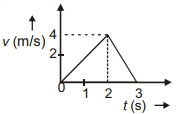
The velocity versus time graph of a body moving in a straight line is as shown in the figure below
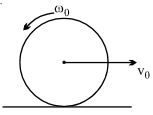
$A$ uniform circular disc placed on $a$ rough horizontal surface has initially a velocity $v_0$ and an angular velocity $\omega_0$ as shown in the figure. The disc comes to rest after moving some distance in the direction of motion. Then $\frac{{{v_0}}}{{r{\omega _0}}}$ is
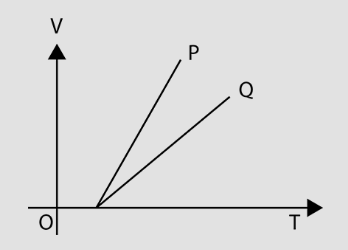
Figure shows the V−T graph for two particles P and Q. The relative velocity of P w.r.t. Q is: