MCQ
Light owes its colour to its :
  • A
    Frequency
  • B
    Velocity
  • Phase
  • D
    Amplitude

Answer

Correct option: C.
Phase
C

Need a full question paper?

Generate a complete, print-ready paper with questions like this in minutes — across 16+ boards, with answer keys.

Start Generating Free

Similar questions

Which of the following metals is not sensitive to visible light?
Choose the correct statement:

Focal length of a plane mirror is

(a) Zero

(b) Infinite

(c) Very less

(d) Indefinite

Which of the following particles will describe the smallest circle when projected with the same velocity perpendicular to a magnetic field?
One conducting U tube can slide inside another as shown in figure, maintaining electric contacts between the tubes. The magnetic field B is perpendicular to the plane of the figure. If each tube moves towards the other at a constant speed v, then the emf induced in the circuit in terms of B, l and v where l is the width of each tube, will be
A bar magnet is released from rest along the axis of a very long, vertical copper tube. After some time the magnet:
  1. Will stop in the tube.
  2. Will move with almost content speed.
  3. Will move with an acceleration g.
  4. Will oscillate.
The AC voltage across a resistance can be measured using:
  1. A potentiometer.
  2. A hot-wire voltmeter.
  3. A moving-coil galvanometer.
  4. A moving-magnet galvanometer.

If a 30 V, 90 W bulb is to be worked on a 120 V line, a resistance of how many ohms should be connected in series with the bulb

(a) 10 ohm

(b) 20 ohm

(c) 30 ohm

(d) 40 ohm

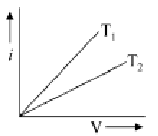
In the given figure, V-i graph of a conductor at two different temperatures is shown. If resistances corresponding to these temperatures are $R_1$ and $R _2$ respectively, then which of the following statement is correct ?
Image

At what temperature will the resistance of a copper wire become three times its value at 0 oC  (Temperature coefficient of resistance for copper = 4 × 10⁻³ per oC )

(a)  400 oC

(b)  450 oC

(c)  500 oC

(d)  550 oC