MCQ
Lines which represent places of constant angle of dip are called
  • A
    Isobaric lines
  • B
    Isogonic lines
  • Isoclinic lines
  • D
    all of the above

Answer

Correct option: C.
Isoclinic lines
c
Lines which represent places of constant angle of dip are called Isoclinic lines.

Need a full question paper?

Generate a complete, print-ready paper with questions like this in minutes — across 16+ boards, with answer keys.
Start Generating Free

Similar questions

In Bohr model of hydrogen atom, the ratio of periods of revolution of an electron in n = 2 and n = 1 orbits is
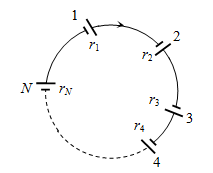
A group of N cells whose emf varies directly with the internal resistance as per the equation $E_N=1.5 r_N$ are connected as shown in the figure below. The current I in the circuit is
A capacitor is connected to a $20\, {V}$ battery through a resistance of $10\, \Omega .$ It is found that the potential difference across the capacitor rises to $2\, {V}$ in $1\, \mu {s}$. The capacitance of the capacitor is $....\,\mu {F}$ Given : $\ln \left(\frac{10}{9}\right)=0.105$
The reason for attractive force between two parallel wires in which current is flowing in same direction is:
A pulse of light of duration $100 \ ns$ is absorbed completely by a small object initially at rest. Power of the pulse is $30 \ mV$ and the speed of light is $3 \times 10 ^8\ ms ^{-1}$. The final momentum of the object is :
What will be the colour of sky as seen from the earth, if there were no atmosphere
In the circuit shown in figure
The average $e.m.f$ induced in a coil in which the current changes from $2$ $ampere$ to $4$ $ampere$ in $0.05$ $second$ is $8$ $volt.$ What is the self inductance of the coil ?......$H$
A radioactive nucleus $A$ has a single decay mode with half-life $\tau_A$. Another radioactive nucleus $B$ has two decay modes $1$ and $2$. If decay mode $2$ were absent, the half-life of $B$ would have been $\tau_A / 2$. If decay mode $1$ were absent, the half-life of $B$ would have been $3 \tau_A$. If the actual half life of $B$ is $\tau_B$, then the ratio $\tau_B / \tau_A$ is
The workfunctions of three metals $A, B$ and $C$ are $W_A, W_B$ and $W_C$ respectively. They are in the decreasing order. The correct graph between kinetic energy of emitted electron and frequency $v$ of incident radiation is