MCQ
Liquids $ A$  and $B$ form an ideal solution
  • The enthalpy of mixing is zero
  • B
    The entropy of mixing is zero
  • C
    The free energy of mixing is zero
  • D
    The free energy as well as the entropy of mixing are each zero

Answer

Correct option: A.
The enthalpy of mixing is zero
a
For an ideal solution, we know that:-

$a) V _{\text {mix }}=0$

$b) H _{\text {mix }}=0$

$c) \Delta G _{\text {mix }}=-v e$

Final Answer : Hence, option $A$ is correct.

Need a full question paper?

Generate a complete, print-ready paper with questions like this in minutes — across 16+ boards, with answer keys.

Start Generating Free

Similar questions

If on adding $FeCl_3$ solution to acidified Lassaigne solution, of organic compound a blood redcolouration is producted, it indicates the presence of 
Which one of the following statements is correct?
Oxidation number of $S$ in ${S^{2 - }}$ is
On passing a current through molten $KCl$, $19.5\, g$ of potassium is deposited. If the same quantity of electricity is passed through molten aluminium chloride then the amount of aluminium deposited will be ............. $\mathrm{g}$
Unit of equilibrium constant for the reversible reaction ${H_2} + {I_2}$ $\rightleftharpoons$ $2HI$ is
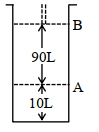
Consider the figure provided.

$1 \mathrm{~mol}$ of an ideal gas is kept in a cylinder, fitted with a piston, at the position $\mathrm{A}$, at $18^{\circ} \mathrm{C}$. If the piston is moved to position $B$, keeping the temperature unchanged, then ' $x$ ' $L$ atm work is done in this reversible process.

$\mathrm{x}=$ . . . . . . $\mathrm{L} \mathrm{atm.} \mathrm{(nearest} \mathrm{integer)}$

[Given : Absolute temperature $={ }^{\circ} \mathrm{C}+273.15$, $\left.\mathrm{R}=0.08206 \mathrm{~L} \mathrm{~atm} \mathrm{~mol}^{-1} \mathrm{~K}^{-1}\right]$
When sodium reacts with ethyl iodide, which of the following hydrocarbons is produced
The standard electrode potential of the half cells are given below

$Z{n^{2 + }} + 2{e^ - } \to Zn$ ;          $E = - 7.62\,\,V,$

$F{e^{2 + }} + 2{e^ - } \to Fe$ ;          $E = - 7.81\,\,V$

The emf of the cell $F{e^{2 + }} + Zn \to Z{n^{2 + }} + Fe$ is ............ $\mathrm{V}$

$\begin{array}{*{20}{c}}
  {\begin{array}{*{20}{c}}
  {C{H_2} - OH} \\ 
  {|\,\,\,\,\,\,\,\,\,\,\,\,\,\,\,\,\,\,\,\,\,\,\,} 
\end{array}} \\ 
  {C{H_2} - OH} \\ 
  {|\,\,\,\,\,\,\,\,\,\,\,\,\,\,\,\,\,\,\,\,\,\,\,} \\ 
  {C{H_2} - SH} 
\end{array}$ ${ + \mathop {C{H_3}MgBr}\limits_{\left( {Excess} \right)}  \to xC{H_4}}$

What is the value of $x$ in the above reaction ?

When the aqueous solution of $0.5\, mole $ $HN{O_3}$ is mixed with the $0.3\, mole$  of $O{H^ - }$ solution, then what will be the liberated heat.......$kJ$ (Enthalpy of neutralization is $= 57.1 \,kJ$ )