Question
List out some common features in cat, rat and bat.

Answer

Cat, bat and rat belong to the class-Mammalia and have following common features:
  1. All have notochord at some stage of their lifecycle.
  2. All are warm-blooded.
  3. All have four-chambered heart.
  4. All have skin covered with hair and have sweat and oil glands.
  5. Body is divisible into head, neck, trunk and tail.
  6. Females have milk producing mammary glands.
  7. Fleshy external ear (pinna) is present.
  8. Respiration is through lungs only.
  9. Excrete urea (ureotelic animals).
  10. Fertilisation is internal.

Need a full question paper?

Generate a complete, print-ready paper with questions like this in minutes — across 16+ boards, with answer keys.
Start Generating Free

Similar questions

What are the different tissues in alimals.
Differentiate between pathogens and pests. How does an insect-pest attack the plants?
Which contains more molecules, $10\ g$ of sulphur dioxide $\left( SO _2\right)$ or $10\ g$ of oxygen $\left( O _2\right)$ ? (Atomic masses: $S =32 u ; O =16 u$ )
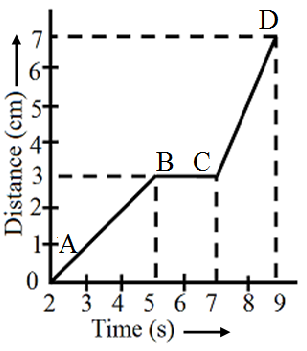
The graph given alogside shows the positions of a body at different times. Calculate the speed of the body as it moves from:
  1. $A$ to $B.$
  2. $B$ to $C.$
  3. $C$ to $D.$
There are four substances $W, X, Y$ and $Z$. The substance $W$ is a dark violet solid having diatomic molecules. A solution of $W$ in alcohol is used as a common antiseptic $C$. The substance $X$ is a white solid which is usually recovered from sea water on a large scale. The substance $Y$ is a white solid which is insoluble in water and used in the form of small balls for the safe storage of woollen clothes. The substance $Z$ is a yet another white solid which is used in making commonly used dry cells.
  1. Name (i) $W$ (ii) $X$ (iii) $Y$ and (iv) $Z$.
  2. Out of $W, X, Y$ and $Z$, which substance/ substances can undergo sublimation?
  3. Which substances organic in nature?
  4. What is the name of substance $C$?
  5. Which substance belongs to the halogen family?
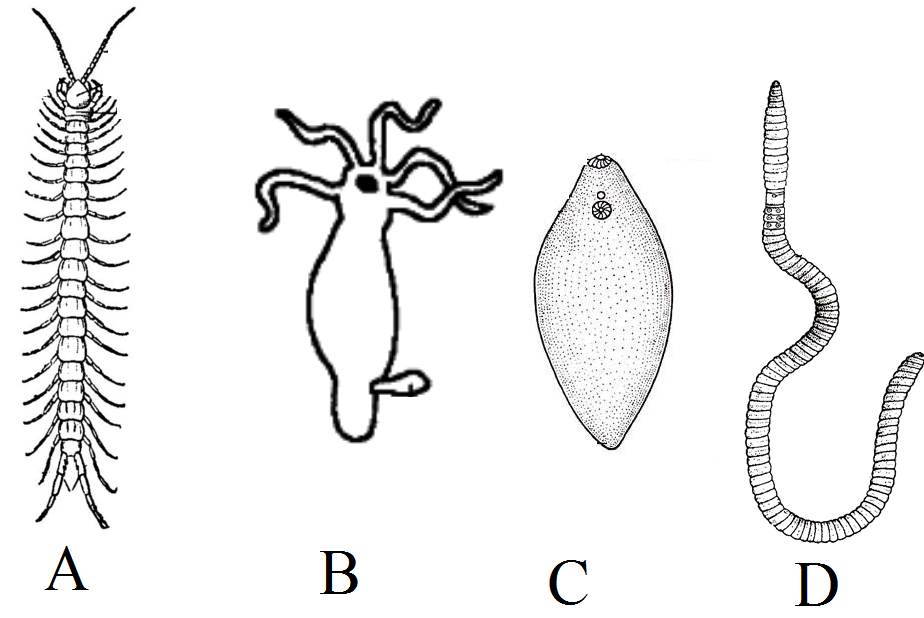
  1. Identify figure A to D.
  2. Which one of them is (i) diplobalstic; (ii) Coelomate?
  3. Which triplobalstic animal is (i) Acoelomate; (ii) Coelomate?
  4. Which one belong to phylum (i) Cnidaria; (ii) Platyhelminthes; (iii) Annelids; (iv) Arthropoda?
  5. Which one of them has (i) Organ level organization? (ii) Organ system level organization?
  6. Which one of them has excretory organs in the form of (i) Flame cells; (ii) Nephridia?
  7. Which one of them has trachea as the respiratory organ? 
What is feed? What are different type of feed? How is it differ with respect to age and functions?
Describe the characteristics used in hierarchial classification of organisms.
Which has more number of atoms, $100$grams of sodium or $100$grams of iron (given, atomic mass of $Na = 23u, Fe = 56u)?$
A mixture contains water, kerosene and sand. How will you separate this mixture?