Question
List the attributes that populations but not individuals possess.

Answer

A population can be defined as a group of individuals of the same species residing in a particular geographical area at a particular time and functioning as a unit. For example, all human beings living at a particular place at a particular time constitute the population of humans. The main attributes or characteristics of a population residing in a given area are:
  1. Birth rate (Natality): It is the ratio of live births in an area to the population of an area. It is expressed as the number of individuals added to the population with respect to the members of the population.
  2. Death rate (Mortality): It is the ratio of deaths in an area to the population of an area. It is expressed as the loss of individuals with respect to the members of the population.
  3. Sex ratio: It is the number of males or females per thousand individuals.
  4. Age Distribution: It is the percentage of individuals of different ages in a given population. At any given time, the population is composed of individuals that are present in various age groups. The age distribution pattern is commonly represented through age pyramids.
  5. Population density: It is defined as the number of individuals of a population present per unit area at a given time.

Need a full question paper?

Generate a complete, print-ready paper with questions like this in minutes — across 16+ boards, with answer keys.

Start Generating Free

Similar questions

How is the placenta connected to the embryo?
  1. Following are the responses of different animals to various abiotic factors. Describe each one with the help of an example.
  1. Regulate.
  2. Conform.
  3. Migrate.
  4. Suspend.
  1. If 8 individuals in a population of 80 butterflies die in a week, calculate the death rate of population of butterflies during that period.

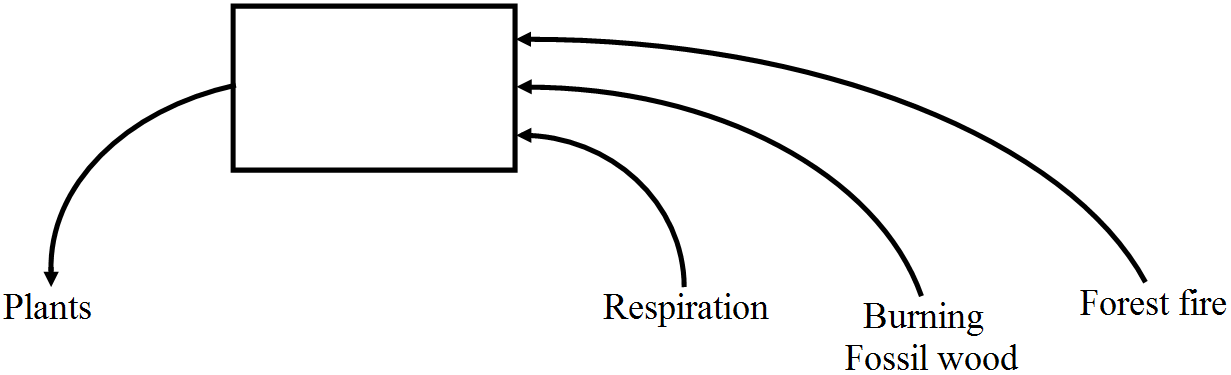
The above diagram shows a simplified biogeochemical cycle.

  1. Name the compound whose cycle is depicted.
  2. In what way do vehicles add this compound to atmosphere?
  3. What adverse effect does its excess have on the environment?
  4. Cite an event which depicts this effect in the modern times.
  5. Suggest two ways of reducing this effect.
What is global warming? Describe main causes of global warming.
Draw a labelled diagram of the L.S. of embryo of grasses. How does it differ from that of bean?
Observe the representation of genes involved in the lac operon given below.

  1. Identify the region where the repressor protein will attach normally.
  2. Under certain conditions repressor is unable to attach at this site. Explain.
  3. If repressor fails to attach to the said site what products will be formed by z, y and a?
  4. Analyse why this kind of regulation is called negative regulation.
A flower of tomato plant following the process of sexual reproduction produce 240 viable seeds.
Answer the following questions giving reasons:
How many male gametes were involved in this case?
What is menstrual cycle. Explain its various events with the help of diagram.###Describe in detail the various stages of menstrual cycle with the help of diagram.###Write a detail note on different stages of menstrual cycle and also sketch out these stages of
menstrual cycle by graphical diagram.###Define sexual reproduction. Explain the process of menstrual cycle.
Two heterozygous parents are crossed. If the two loci are linked what would be the distribution of phenotypic features in F1 generation for a dibybrid cross?
Why should biological control of pests and pathogens be preferred to the conventional use of chemical pesticides? Explain how the following microbes act as biocontrol agents:
  1. Bacillus thuringiensis.
  2. Nucleopoly hedrovirus.