Question
List the differences between a progressive and a stationary wave.

Answer

S. No.
Progressive Wave
Stationary Wave
1.
All particles have same phase and amplitude.
Amplitude varies with position.
2.
Speed of motion is same.
Speed varies with position.
3.
Energy is transported.
Energy is not transported.
4.
Same change in pressure and density is with every point.
Pressure and density varies with point.

Need a full question paper?

Generate a complete, print-ready paper with questions like this in minutes — across 16+ boards, with answer keys.
Start Generating Free

Similar questions

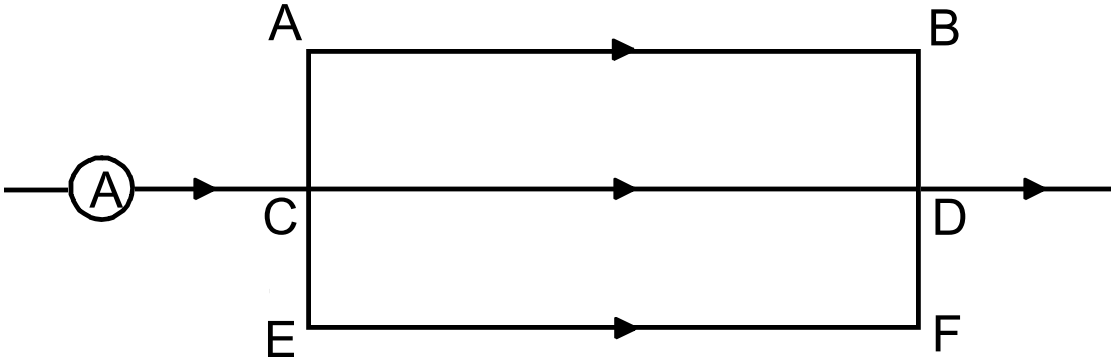
Figure shows a part of an electric circuit. The wires AB, CD and EF are long and have identical resistances. The separation between the neighbouring wires is 1.0cm. The wires AE and BF have negligible resistance and the ammeter reads 30A. Calculate the magnetic force per unit length of AB and CD.

A cubical box of volume 216cm3 is made up of 0.1cm thick wood. The inside is heated electrically by a 100W heater. It is found that the temperature difference between the inside and the outside surface is 5°C in steady state. Assuming that the entire electrical energy spent appears as heat, find the thermal conductivity of the material of the box.
The magnetic field B inside a long solenoid, carrying a current of 5.00A, is 3.14 × 10⁻²T. Find the number of turns per unit length of the solenoid.
An artificial satellite is moving in a circular orbit around the earth with a speed equal to half the magnitude of escape velocity from earth. Determine
  1. The height of satellite above earth's surface.
  2. If the satellite is suddenly stopped, find the speed with which the satellite will hit the earth's surface after falling down.
Satellite A is in a certain circular orbit about a planet, while satellite B is in a larger circular orbit. Which satellite has (i) the longer period and (ii) the greater speed?
What is meant by parallax? How can we find the distance of a nearby star by parallax method?

OR

Given measurement a1, a2, a3 ________ an. With the help of these, explain absolute error, relative error and percent -age error.

Estimate the change in the density of water in ocean at a depth of 400m below the surface. The density of water at the surface = 1030kg/m3 and the bulk modulus of water = 2 × 10⁹N/m2.
Solve the previous problem if the paperweight is inverted at its place so that the spherical surface touches the paper.
A player throws a ball upwards with an initial speed of 29.4m s–1.
Choose the x = 0m and t = 0s to be the location and time of the ball at its highest point, vertically downward direction to be the positive direction of x-axis, and give the signs of position, velocity and acceleration of the ball during its upward, and downward motion.
What is terminal velocity and derive an expression for it?