Question
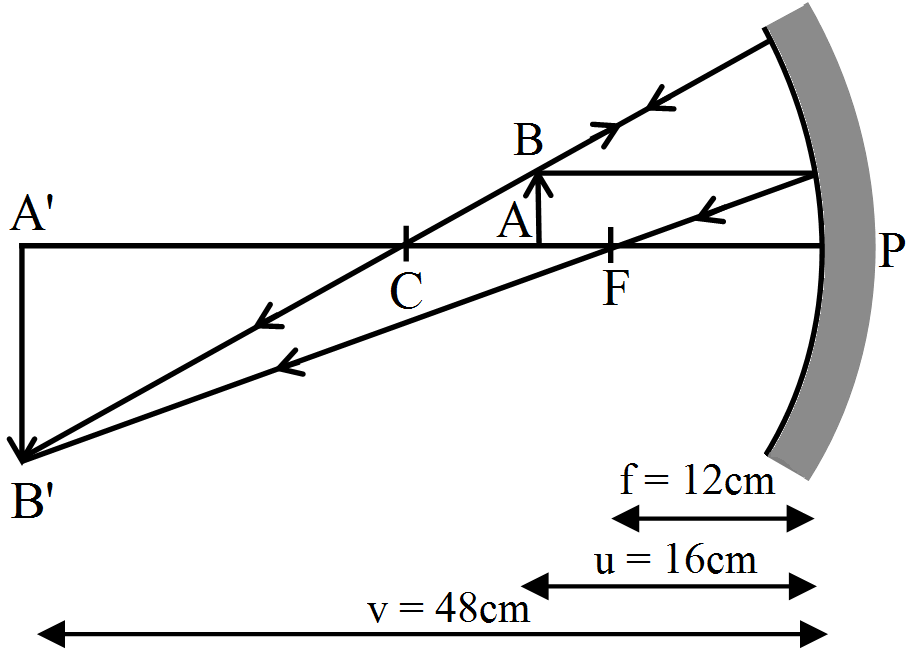
List the sign conventions for reflection flight by spherical mirrors. Draw a diagram and apply these conventions in the determination of focal length of spherical mirror which forms a three times magnified real image of an object placed 16 cm infront of it.
Answer

Sign conventions for reflection of light by spherical mirror are:
  1. The object is always placed to the left of the mirror.
  2. All the distances parallel to the principal axis are always measured from the pole of the spherical mirror.
  3. All the distances measured along the direction of incident light (along +ve x-axis), are considered to be positive.
  4. Those distances measured opposite to the direction of incidence light (i.e. along -ve x-axis), are taken as negative.
  5. The distances measured in upward direction, i.e. perpendicular to and above the principal axis (along +ve y-axis), are taken as positive.
  6. The distances measured in the downward direction, (along -ve y-axis), i.e. perpendicular to and below the principal axis are taken as negative.
From the question

u = -16cm, m = -3 for real


But $\text{m}=-\frac{\text{v}}{\text{u}}=-3$

$\Rightarrow\text{v}=3\text{u}=3(-16)=-48\text{cm}.$

Using mirror fornula

$\frac{1}{\text{f}}=\frac{1}{\text{v}}+\frac{1}{\text{u}}$

We get, $=\frac{1}{\text{f}}=\frac{1}{-48}+\frac{1}{-16}$

$=\frac{1}{-48}+\frac{1}{-16}=\frac{-1-3}{48}=\frac{-4}{48}=\frac{-1}{12}$

$\text{f}=-12\text{cm}$

So, focal lenght of spherical mirror is 12cm. Negative sign of focal length indicates that mirror is concave in nature.

Need a full question paper?

Generate a complete, print-ready paper with questions like this in minutes — across 16+ boards, with answer keys.

Start Generating Free

Similar questions

  1. Write the functions of the following parts in human female reproductive system:
  1. Ovary.
  2. Oviduct.
  3. Uterus.
  1. Describe the structure and function of placenta.
A cylindrical structure P in our body begins in continuation with medulla and extends downwards. It is enclosed in a bony cage Q and surrounded by membranes R. As many as x pairs of nerves arise from the structure P. The structure P is involved in the reflex actions of our body and conduction of nerve impulses to and from another organ S of our body with which it forms CNS.
  1. Name the structure P.
  2. Name (i) bony cage Q, and (ii) membranes R.
  3. How much is x?
  4. Name the organs S.
  5. What are the reflexes involving structure P only known as?
i. Distinguish between hormonal co-ordination in plants and animals.
ii. Which part of the brain is responsible for -
1. intelligence
2. riding a bicycle
3. vomiting
4. controlling hunger
iii. How is brain and spinal-cord protected against mechanical injuries?
In a village in Karnataka, people started cultivating crops all around a lake which was always filled with water. They added fertilisers to their field in order to enhance the yield. Soon they discovered that the waterbody was completely covered with green floating plants and fishes started dying in large numbers.
Analyse the situation and give reasons for excessive growth of plants and death of fish in the lake.
i. Name the mode of reproduction of the following organisms and state the important feature of each mode:
a. Planaria
b. Hydra
c. Rhizopus
ii. We can develop new plants from the leaves of Bryophyllum. Comment.
iii. List two advantages of vegetative propagation over other modes of reproduction.
Why does a magnetic compass needle pointing North and South in the absence of a nearby magnet get deflected when a bar magnet or a current carrying loop is brought near it. Describe some salient features of magnetic lines of field concept.
An element E exists in three allotropic forms A, B and C. In allotrope A, the atoms of element E are joined to form spherical molecules. In allotrope B, each atom of element E is surrounded by three other E atoms to form a sheet like structure. In allotrope C, each atom of element E is surrounded by four other E atoms to form a rigid structure.
  1. Name the element E.
  2. What is allotrope A.
  3. What is allotrope B?
  4. What is allotrope C?
  5. Which allotrope is used in making jewellery?
  6. Which allotrope is used in making anode of a dry cell?
Find the valency of first twenty elements.
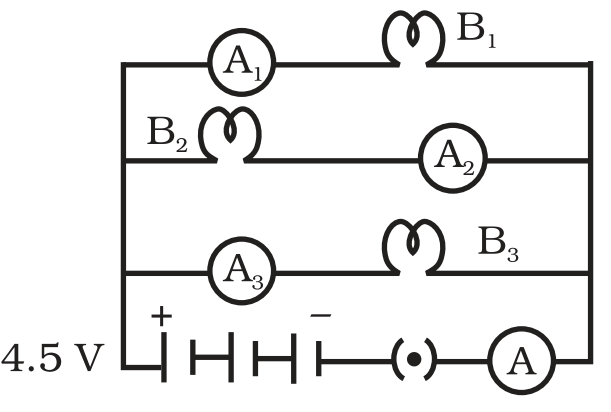
$B_1, B_2$ and $B_3$ are three identical bulbs connected as shown in Figure. When all the three bulbs glow, a current of 3 A is recorded by the ammeter A
.
i. What happens to the glow of the other two bulbs when the bulb $B_1$ gets fused?
ii. What happens to the reading of $A_1, A_2, A_3$ and $A$ when the bulb $B_2$ gets fused?
iii. How much power is dissipated in the circuit when all the three bulbs glow together?
What is a synapse? What happens at the synapse between two neurons? How are the messages carried across a synapse? Explain with the help of a labelled diagram.