Question
  1. List two main differences between orbit and orbital.
  2. If an electron is moving with a velocity 600m/ s which is accurate upto 0.005%, then calculate the uncertainty in its position.
($h = 6.626 \times 10^{-34}Js$ and mass of election = $9.11 \times 10^{-31}kg$)

Answer

  1. Differences between orbit and orbitals:
S. No
Orbit
Orbital
1.
Orbit is a well defined2-D circular path around the nucleus in which the electrons revolve.
Orbital is a 3-D space around the nucleus within which the probability of finding the electrons is maximum
2.
Concept of orbit is not in Accor-dance with the wave nature of electrons.
It is in accordance with the wave nature of electrons.
3.
Orbits do not have directional characteristics.
All orbital’s except s-orbital have directional characteristics.
  1. Uncertainty in speed, $\Delta\text{V}=\frac{0.005}{100}\times600\text{m/ s}$
$=0.03\text{ms}^{-1}$

Heisenberg Uncertainty Principle,

$\Delta\text{x} \times\text{m}\Delta\text{V}=\frac{\text{h}}{4\pi},\Delta\text{x}=$ Uncertainty in position,

$\Rightarrow\Delta\text{x}=\frac{6.626\times10^{-34}\text{Js}}{4\times\frac{22}{7}\times9.11\times10^{-31}\text{kg}\times0.03\text{ms}^{-1}}$

$=1.93\times10^{-3}\text{m}$

Need a full question paper?

Generate a complete, print-ready paper with questions like this in minutes — across 16+ boards, with answer keys.
Start Generating Free

Similar questions

Use Lewis symbols to show electron transfer between the following atoms to form cations and anions: K and S.
What do you understand by,
  1. Inert pair effect.
  2. Allotropy.
  3. Catenation.
A vessel contains 1.6g of dioxygen at STP ($273.15K, 1$ atm pressure). The gas is now transferred to another vessel at constant temperature, where pressure becomes half of the original pressure. Calculate
  1. Volume of the new vessel.
  2. Number of molecules of dioxygen.
What is meant by hybridisation? Compound $\mathrm{CH}_2=\mathrm{C}=\mathrm{CH}_2$ contains sp or $\mathrm{sp}^2$ hybridised carbon atoms. Will it be a planar molecule?
Complete the following reactions:
  1. $\text{K}_4[\text{Fe}(\text{CN)}_6]+\text{H}_2\text{O}_2+\text{H}_2\text{SO}_4\xrightarrow{\ \ \ \ \ \ \ }$
  2. $\text{HOCl}+\text{H}_2\text{O}_2\xrightarrow{\ \ \ \ \ \ \ \ }$
  3. $\text{K}_2\text{Cr}_2\text{O}_7+\text{H}_2\text{SO}_4+\text{H}_2\text{O}_2\xrightarrow{\ \ \ \ \ \ }$
What is meant by entropy? Predict the sign of entropy change in each of the following:
  1. $\left.\mathrm{H}_2 \text { (at } 298 \mathrm{~K}, 1 \mathrm{~atm}\right) \rightarrow \mathrm{H}_2 \text { (at } 298 \mathrm{~K}, 10 \text { atm) }$
  2. $\mathrm{H}_2 \mathrm{O}(\text { at } 298 \mathrm{~K}, 1 \mathrm{~atm}) \rightarrow \mathrm{H}_2 \mathrm{O} \text { (at } 330 \mathrm{~K}, 1 \text { atm) }$
  3. $2 \mathrm{NH}_4 \mathrm{NO}_3(\mathrm{~s}) \rightarrow 2 \mathrm{~N}_2(\mathrm{~g})+4 \mathrm{H}_2 \mathrm{O}(\mathrm{g})+\mathrm{O}_2(8)$
  4. Crystallization of copper sulphate from its saturated solution.
  5. $2\text{SO}_2(\text{g})+\text{O}_2(\text{g})\rightleftharpoons2\text{SO}_3(\text{g}).$
According to de Broglie, matter should exhibit dual behaviour, that is both particle and wave like properties. However, a cricket ball of mass 100 g does not move like a wave when it is thrown by a bowler at a speed of 100 $km / h$. Calculate the wavelength of the ball and explain why it does not show wave nature.
10g of argon is compressed isothermally and reversibly at a temperature of 27°C from 10L to 5L. Calculate q, W, $\Delta\text{U}$ and $\Delta\text{H}$ for this process. $R = 2.0cal K^{-1} mol^{-1}$, log2 = 0.30, atomic weight, of Ar = 40.
Note: Consider structures I to VII and answer the questions:
  1. $\text{CH}_3-\text{CH}_2-\text{CH}_2-\text{CH}_2-\text{OH}$
  2. $\text{CH}_3-\text{CH}_2-\text{CH}-\text{CH}_3\\\ \ \ \ \ \ \ \ \ \ \ \ \ \ \ \ \ \ \ \ \ \ \ \ \ \ |\\\ \ \ \ \ \ \ \ \ \ \ \ \ \ \ \ \ \ \ \ \ \ \ \ \ \text{OH}$
  3. $\ \ \ \ \ \ \ \ \ \ \ \ \text{CH}_3\\\ \ \ \ \ \ \ \ \ \ \ \ \ |\\\text{CH}_3-\text{C}-\text{CH}_3\\\ \ \ \ \ \ \ \ \ \ \ \ \ |\\\ \ \ \ \ \ \ \ \ \ \ \ \text{OH}$
  4. $\text{CH}_3-\text{CH}-\text{CH}_2-\text{OH}\\\ \ \ \ \ \ \ \ \ \ \ \ \ \ \ \ \ \ \ \ \ \ \ \ |\\\ \ \ \ \ \ \ \ \ \ \ \ \ \ \ \ \ \ \ \ \ \ \ \text{CH}_3$
  5. $\text{CH}_3-\text{CH}_2-\text{O}-\text{CH}_2-\text{CH}_3$
  6. $\text{CH}_3-\text{O}-\text{CH}_2-\text{CH}_2-\text{CH}_3$
  7. $\text{CH}_3-\text{O}-\text{CH}-\text{CH}_3\\\ \ \ \ \ \ \ \ \ \ \ \ \ \ \ \ \ \ \ \ \ \ |\\\ \ \ \ \ \ \ \ \ \ \ \ \ \ \ \ \ \ \ \ \ \text{CH}_3$
Identify the pairs of compounds that represents position isomerism.
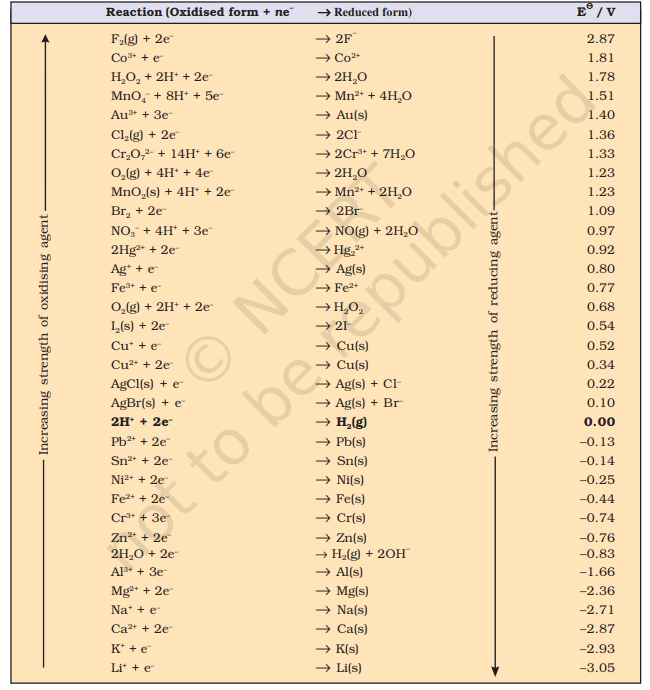
Using the standard electrode potentials given in the Table, predict if the reaction between the following is feasible:

$\mathrm{Br}_2(\mathrm{aq})$ and $\mathrm{Fe}^{2+}(\mathrm{aq})$