MCQ
$\text{ll Cu(II)}$ halides are known except the iodide. The reason for it is that:
  • A
    iodide is a bulky ion.
  • $Cu^{2+}$ oxidizes iodide to iodine.
  • C
    $\text{Cu}^{2+}_\text{(aq)}$ has much more negative hydration enthalpy.
  • D
    $Cu^{2+}$ ion has smaller size.

Answer

Correct option: B.
$Cu^{2+}$ oxidizes iodide to iodine.
All $\text{Cu(II)}$ halides are known except the iodine because $Cu^{2+}$ oxidizes iodine to iodine.
$2 \mathrm{Cu}^{2+}+4 \mathrm{I}^{-1} \rightarrow 2 \mathrm{CuI}_{(\mathrm{S})}+\mathrm{I}_2$.

Need a full question paper?

Generate a complete, print-ready paper with questions like this in minutes — across 16+ boards, with answer keys.

Start Generating Free

Similar questions

The total number of tetrahedral voids in the face centred unit cell is $......$
An organic compound $[A],$ molecular formula $C _{10} H _{20} O _{2}$ was hydrolyzed with dilute sulphuric acid to give a carboxylic acid $[ B ]$ and alcohol $[C].$ Oxidation of $[C]$ with CrO $_{3}- H _{2} SO _{4}$ produced $[B].$ Which of the following structures are not possible for $[ A ] ?$
The rate constant for the reaction $2N_2O_5 \to  4NO_2 + O_2$ is $3.0\times10^{-5}\, sec^{-1}$. If rate is $2.40\times10^{-5}\, M\, sec^{-1}$, then the concentration of $N_2O_5$ (in $M$) is ?
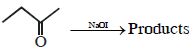
Correct products of reaction are ?
Assertion : $HClO_4$ is a strong acid than $HClO_3$.

Reason : Oxidation state of $Cl$ in $HClO_4$ is $+7$ and in $HClO_3$, it is $+ 5$.

$\begin{gathered}
  \begin{array}{*{20}{c}}
  {O\,\,\,\,\,\,\,\,\,\,\,\,\,\,\,\,\,\,\,\,\,\,\,\,\,\,\,\,\,\,\,\,\,\,\,\,\,\,\,\,\,\,\,\,\,\,\,\,\,\,\,\,\,\,\,\,\,\,\,\,\,\,\,\,\,\,\,\,\,\,\,\,\,\,} \\ 
  {||\,\,\,\,\,\,\,\,\,\,\,\,\,\,\,\,\,\,\,\,\,\,\,\,\,\,\,\,\,\,\,\,\,\,\,\,\,\,\,\,\,\,\,\,\,\,\,\,\,\,\,\,\,\,\,\,\,\,\,\,\,\,\,\,\,\,\,\,\,\,\,\,\,\,} \\ 
  {C{H_3} - {\text{  }}C - {\text{ }}O - H\xrightarrow{{NaH{{\mathop {CO}\limits^{14} }_3}}}\mathop {(A)}\limits_{(gas)} \xrightarrow[{(ii){H_3}{O^ \oplus }}]{{(i)PhMgBr}}(B)} 
\end{array} \hfill \\
  \begin{array}{*{20}{c}}
  {O\,\,\,\,\,\,\,\,\,\,\,\,\,\,\,\,\,\,\,\,\,\,\,\,\,\,\,\,\,\,\,\,\,\,\,\,\,\,\,\,\,\,\,\,\,\,\,\,\,\,\,\,\,\,\,\,\,\,\,\,\,\,\,\,\,\,\,\,\,\,\,\,\,\,} \\ 
  {||\,\,\,\,\,\,\,\,\,\,\,\,\,\,\,\,\,\,\,\,\,\,\,\,\,\,\,\,\,\,\,\,\,\,\,\,\,\,\,\,\,\,\,\,\,\,\,\,\,\,\,\,\,\,\,\,\,\,\,\,\,\,\,\,\,\,\,\,\,\,\,\,\,\,} \\ 
  {C{H_3} - S - O - H\xrightarrow{{NaH\mathop {C{O_3}}\limits^{14} }}\mathop {(C)}\limits_{(gas)} \xrightarrow[{(ii){H_3}{O^ \oplus }}]{{(i)PhMgBr}}(D)} \\ 
  {||\,\,\,\,\,\,\,\,\,\,\,\,\,\,\,\,\,\,\,\,\,\,\,\,\,\,\,\,\,\,\,\,\,\,\,\,\,\,\,\,\,\,\,\,\,\,\,\,\,\,\,\,\,\,\,\,\,\,\,\,\,\,\,\,\,\,\,\,\,\,\,\,\,\,\,} \\ 
  {O\,\,\,\,\,\,\,\,\,\,\,\,\,\,\,\,\,\,\,\,\,\,\,\,\,\,\,\,\,\,\,\,\,\,\,\,\,\,\,\,\,\,\,\,\,\,\,\,\,\,\,\,\,\,\,\,\,\,\,\,\,\,\,\,\,\,\,\,\,\,\,\,\,\,\,\,} 
\end{array} \hfill \\ 
\end{gathered}$

Product $(B)$ and $(D) $ in the above reaction are

$\,$
A semipermeable membrane used in the measurement of osmotic pressure of a solution allows the passage of
If one mole of a substance is present in $1\,kg$ of solvent, then
White precipitate of $AgCl$ dissolves in aqueous ammonia solution due to formation of ..... .