Question
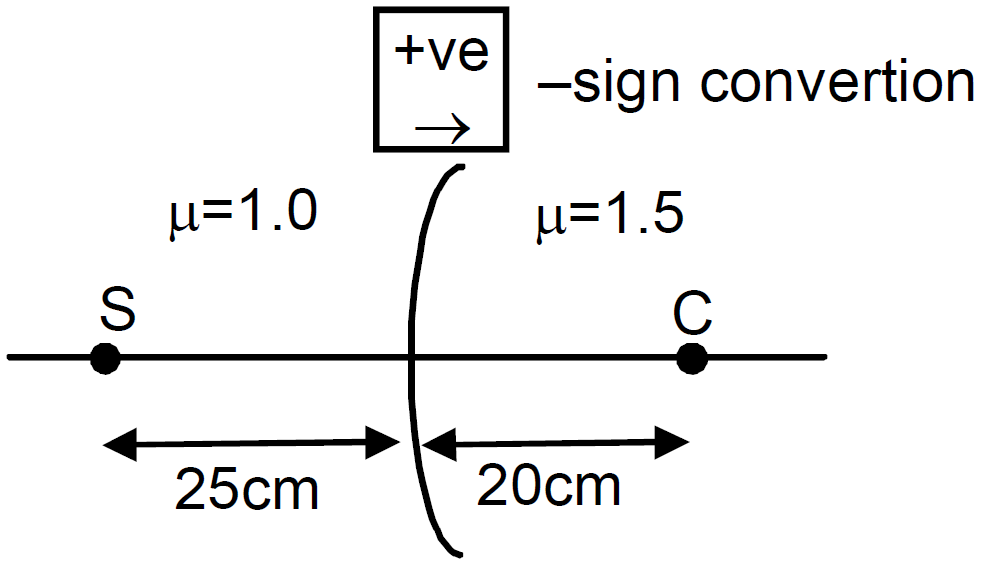
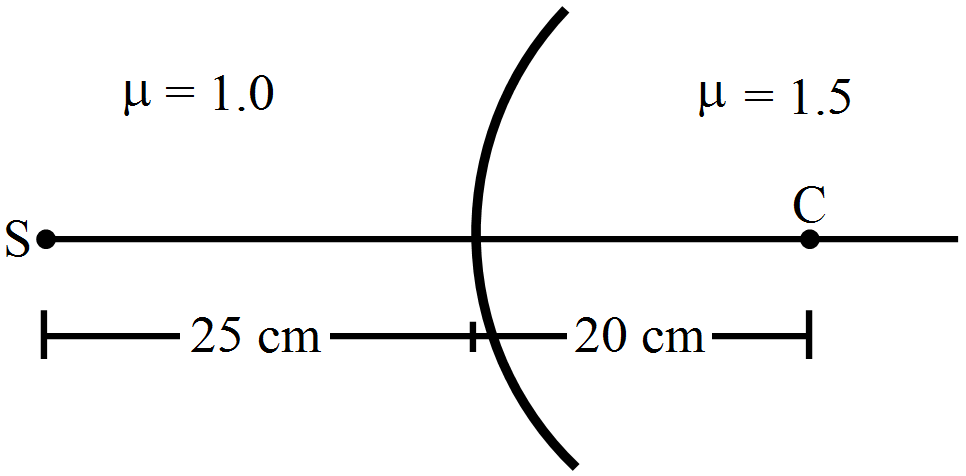
Locate the image formed by refraction in the situation shown in figure.

Answer

$\mu_1=1, \ \mu_2=1.5,$
R = 20cm (Radius of curvature), u = -25cm$\therefore \ \frac{\mu_2}{\text{v}}-\frac{\mu_1}{\text{u}}=\frac{\mu_2-\mu_1}{\text{R}}$
$\Rightarrow\frac{1.5}{\text{v}}=\frac{0.5}{20}-\frac{1}{25}=\frac{1}{40}-\frac{1}{25}=\frac{-3}{200}$
$\Rightarrow \ \text{v}=200\times0.5=-100\text{cm}.$
So, the image is 100cm from (P) the surface on the side of S.

Need a full question paper?

Generate a complete, print-ready paper with questions like this in minutes — across 16+ boards, with answer keys.

Start Generating Free

Similar questions

Absolute zero temperature is not the temperature of zero energy. Explain.
A block is gently placed at the top of an inclined plane $6.4m$ long. Find the time taken by the block to slide down to the bottom of plane. The plane makes an angle $30°$ with the horizontal. Coefficient of friction between the block and the plane is $0.2$. Take $g = 10m/sec^2$.
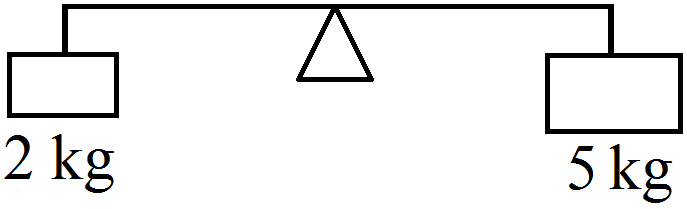
A light rod of length 1m is pivoted at its centre and two masses of 5kg and 2kg are hung from the ends as shown in figure. Find the initial angular acceleration of the rod assuming that it was horizontal in the beginning.
Earth also moves in circular orbit around sun once every year with on orbital radius of $1.5 \times 10^{11}m$. What is the acceleration of earth (or any object on the surface of the earth) towards the centre of the sun? How does this acceleration compare with $g = 9.8m/ s^2$? $\Big(\text{Hint: acceleration}\frac{\text{V}^2}{\text{R}}=\frac{4\pi^2\text{R}}{\text{T}^2}\Big)$
A person travels on a spaceship moving at a speed of $\frac{5\text{c}}{13}$
  1. Find the time interval calculated by him between the consecutive birthday celebrations of his friend on the earth.
  2. Find the time interval calculated by the friend on the earth between the consecutive birthday celebrations of the traveller.
Though the statement quoted above may be disputed, most physicists do have a feeling that the great laws of physics are at once simple and beautiful. Some of the notable physicists, besides Dirac, who have articulated this feeling, are: Einstein, Bohr, Heisenberg, Chandrasekhar and Feynman. You are urged to make special efforts to get access to the general books and writings by these and other great masters of physics. (See the Bibliography at the end of this book.) Their writings are truly inspiring!
Mass of a particle depends on its speed. Does the attraction of the earth on the particle also depend on the particle's speed?
What is the radius of curvature of the parabola traced out by the projectile in the previous problem at a point where the particle velocity makes an angle $\frac{\theta}{2}$ with the horizontal?
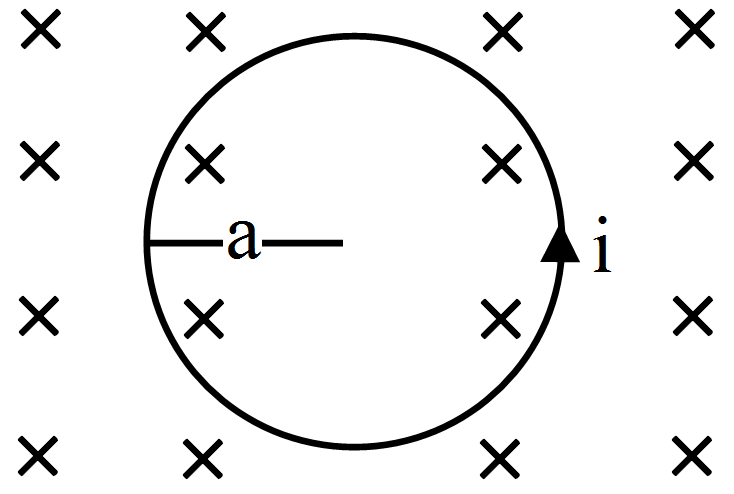
The shows a circular wire loop of radius a and carrying a current $i,$ which is placed in a perpendicular magnetic field $B.$
  1. Consider a small part $dl$ of the wire. Find the force on this part of the wire exerted by the magnetic field.
  2. Find the force of compression in the wire.
By suddenly compressing a gas at a temperature of 300 K, its pressure is made 8 times the initial pressure. Calculate the temperature increase due to compression $(\gamma=1.5)$.