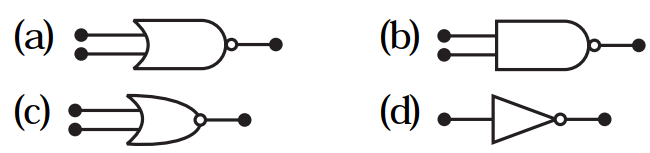
Question
✓
Answer
A
Need a full question paper?
Generate a complete, print-ready paper with questions like this in minutes — across 16+ boards, with answer keys.
Explore more
More "M.C.Q (1 Marks)" from Semiconductor Electronics : Materials Devices and Simple Circuits→Semiconductor Electronics : Materials Devices and Simple Circuits — all question types→Physics STD 12 Science question papers→Rajasthan Board STD 12 Science question papers→Rajasthan Board question paper generator→
Similar questions
In a crystal, the atoms are located at the position of(a) Maximum potential energy (b) Minimum potential energy(c) Zero potential energy(d) Infinite potential energy
If two charges of $1$ coulomb each are placed $1\ km$ apart in vacuum, the force between them will be:
→If an electron and a photon propagate in the form of waves having the same wavelength, it implies that they have the same(a) Energy(b) Momentum(c) Velocity(d) Angular momentum
Eight small drops, each of radius r and having same charge q are combined to form a big drop. The ratio between the potentials of the bigger drop and the smaller drop is
A proton and an alpha particle both enter a region of uniform magnetic field B, moving at right angles to field B. If the radius of circular orbits for both the particles is equal and the kinetic energy acquired by proton is 1 MeV the energy acquired by the alpha particle will be:
In an ac circuit, the potential differences across an inductance and resistance joined in series are, respectively, 16V and 20V. The total potential difference across the circuit is.
Which of the following statements is false?
The colour of bright fringes nearest to the central achromatic fringe in the interference pattern with white light will be:
The magnetic susceptibility of any paramagnetic material changes with absolute temperature T as(a) Directly proportional to T(b) Remains constant(c) Inversely proportional to T(d) Exponentially decaying with T
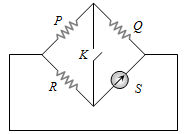
In the following Wheatstone bridge $P/Q = R/S.$ If key $K$ is closed, then the galvanometer will show deflection
→