- ✓$\frac{d N}{d t}=r N\left(\frac{K-N}{K}\right)$
- B$\frac{d N}{d t}=r N\left(\frac{K-N}{N}\right)$
- C$\frac{d N}{d t}=r N\left(\frac{K+N}{K}\right)$
- D$\frac{d N}{d t}=r N\left(\frac{K}{K+N}\right)$
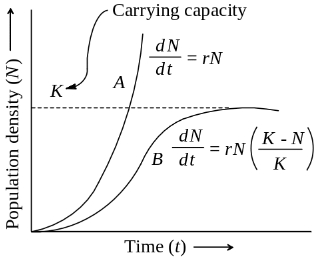
Logistic Growth Model No population can continue to grow exponentially, as the resource availability become limiting at certain point of time. Logistic growth model have fixed carrying capacity
It is described by the equation $\frac{d N}{d t}=r N\left(\frac{K-N}{K}\right)$ Rate of change of population density
$N=$ Population density at time
$N=$ Population density
$r=$ Intrinsic rate of natural increase
$K=$ Carrying capacity
Population growth curve $A$ when resources are not limiting. Plot is exponential or geometrical curve $B$. When resources are limiting the growth, plot is logistic
' $K$ ' is carrying capacity
Generate a complete, print-ready paper with questions like this in minutes — across 16+ boards, with answer keys.
| $(a)$ Inhibitor of catalytic activity | $(i)$ Ricin |
| $(b)$ Possess peptide bonds | $(ii)$ Malonate |
| $(c)$ Cell wall material in fungi | $(iii)$ Chitin |
| $(d)$ Secondary metabolite | $(iv)$ Collagen |
Choose the correct option from the following :
$(a)\quad(b)\quad(c)\quad(d)$
| Column$-I$ | Column$-II$ |
| $(a)$ Golgi apparatus | $(i)$ Synthesis of protein |
| $(b)$ Lysosomes | $(ii)$ Trap waste and excretory products |
| $(c)$ Vacuoles | $(iii)$ Formation of glycoproteins and glycolipids |
| $(d)$ Ribosomes | $(iv)$ Digesting biomolecules |
Choose the right match from options given below