MCQ
Longitudinal waves cannot:
  • A
    Have a unique wavelength
  • B
    Transmit energy
  • C
    Have a unique wave velocity
  • Be polarized.

Answer

Correct option: D.
Be polarized.
Explanation:
A longitudinal wave has particle displacement along its direction of motion; thus, it cannot be polarised.

Need a full question paper?

Generate a complete, print-ready paper with questions like this in minutes — across 16+ boards, with answer keys.

Start Generating Free

Similar questions

A plane electromagnetic wave travelling along the $X$-direction has a wavelength of $3\ mm$ . The variation in the electric field occurs in the $Y$-direction with an amplitude $66\  Vm^{-1}$. The equations for the electric and magnetic fields as a function of $x$ and $t$ are respectively :-
An uncharged parallel plate capacitor having a dielectric of constant $K$ is connected to a similar air cored parallel capacitor charged to a potential $V$. The two capacitors share charges and the common potential is $V$. The dielectric constant $K$ is
Audio signal cannot be transmitted because
The transistors provide good power amplification when they are used in
Doping of intrinsic semiconductor is done
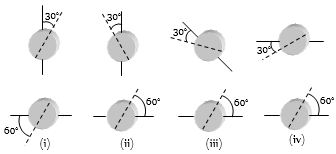
The figure shows four pairs of polarizing sheets, seen face-on. Each pair is mounted in the path of initially unpolarized light. The polarizing direction of each sheet (indicated by the dashed line) is referenced to either a horizontal $x$ - axis or $a$ vertical $y$ axis. Rank the pair according to the fraction of the initial intensity that they pass, greatest first
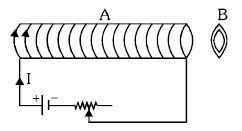
An aluminium ring $B$ faces an electromagnet $A$. The current $I$ through $A$ can be altered. Then which of the following statement is correct
A point object is placed at the centre of a glass sphere of radius $6 \ cm$ and refractive index $1.5.$ The distance of virtual image from the surface of the sphere is
The heat produced by a $100\, watt$ heater in $2$ minute will be equal to
In semiconductors at a room temperature