MCQ
Lorentz force is given by the formula:
  • A
    $F = q(v + B + E)$
  • B
    $F = q(v – B – E)$
  • C
    $F = q(v \times B \times E)$
  • $F = q(v \times B + E)$

Answer

Correct option: D.
$F = q(v \times B + E)$

Lorentz force is given by the formula $F= q(v \times B + E)$

Need a full question paper?

Generate a complete, print-ready paper with questions like this in minutes — across 16+ boards, with answer keys.
Start Generating Free

Similar questions

Critical angle is that angle of incidence in the denser medium for which the angle of refraction in rarer medium is......$^o$
A student says that he had applied a force $\text{F}=-\text{k}\sqrt{\text{x}}$ on a particle and the particle moved in simple harmonic motion. He refuses to tell whether k is a constant or not. Assume that he was worked only with positive x and no other force acted on the particle.
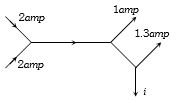
The figure below shows currents in a part of electric circuit. The current $i$ is ............. $amp$
The frequency order for $\gamma -$ rays $(a)$, $X-$ rays $(b)$ and $UV-$ rays $(c)$ is given as
An electric dipole placed in a uniform electric field experiences maximum moment of couple when the dipole is placed
$STATEMENT-1$ For practical purposes, the earth is used as a reference at zero potential in electrical circuits.and

$STATEMENT-2$ The electrical potential of a sphere of radius $R$ with charge $\mathrm{Q}$ uniformly distributed on the surface is given by $\frac{\mathrm{Q}}{4 \pi \varepsilon_0 R}$.
The ratio of momenta of an electron and an $\alpha - $particle which are accelerated from rest by a potential difference of $100 V$ is
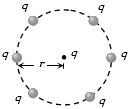
A point charge is surrounded symmetrically by six identical charges at distance $r$ as shown in the figure. How much work is done by the forces of electrostatic repulsion when the point charge $q$ at the centre is removed at infinity
An astronaut floating freely in space decides to use his flash light as a rocket. He shines a $10$ watt light beam in a fixed direction so that he acquires momentum in the opposite direction. If his mass is $80$ kg, how long must he need to reach a velocity of $1$ $ms^{-1}$
The inductance of a solenoid $0.5 \,m$ long of cross-sectional area $20\, cm^2$ and with $500$ turns is......$mH$