MCQ
Lucas reagent is
- ✓Anhydrous $ZnC{l_2} + conc.\,HCl$
- BHydrous $ZnC{l_2} + dil.\,HCl$
- CConc. $HN{O_3} + $ anhydrous $ZnC{l_2}$
- DConc. $HN{O_3} + $ anhydrous $MgC{l_2}$
This solution is used to classify alcohols of low molecular weight. The reaction is a substitution in which the chloride replaces a hydroxyl group. The best results for this test are observed in tertiary alcohols, as they form the respective alkyl halides fastest due to higher stability of the intermediate tertiary carbocation.
The Lucas test in alcohols is a test to differentiate between Primary , secondary , and Tertiary Alcohols. It is based on the difference in reactivity of the three classes of alcohols with hydrogen halides via an SN1 reaction.
Since, the Lucas reagent is Anhydrous $ZnCl _2$ and Conc. $HCl$.
Generate a complete, print-ready paper with questions like this in minutes — across 16+ boards, with answer keys.
$1.$ The product $X$ is
mcq $Image$
$2.$ The correct statement with respect to product $Y$ is :
$(A)$ It gives a positive Tollens test and is a functional isomer of $X$.
$(B)$ It gives a positive Tollens test and is a geometrical isomer of $X$.
$(C)$ It gives a positive iodoform test and is a functional isomer of $X$.
$(D)$ It gives a positive iodoform test and is a geometrical isomer of $X$.
Give the answer question $1$ and $2.$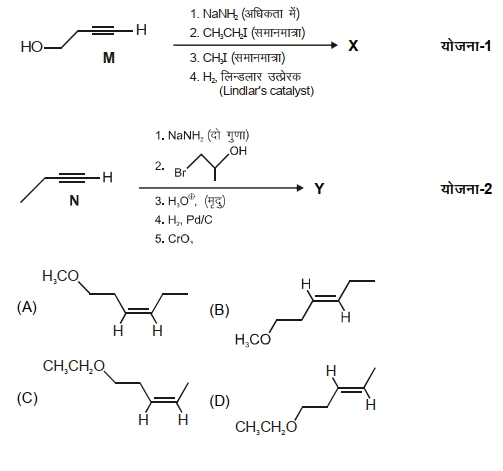
Statement $(I)$ : Kjeldahl method is applicable to estimate nitrogen in pyridine.
Statement $(II)$ : The nitrogen present in pyridine can easily be converted into ammonium sulphate in Kjeldahl method.
In the light of the above statements, choose the correct answer from the options given below.