MCQ
Lysine is least soluble in water in the $pH$ range
  • A
    $3$ to $4$
  • B
    $5$ to $6$
  • $6$ to $7$
  • D
    $8$ to $9$

Answer

Correct option: C.
$6$ to $7$
c
$\begin{array}{*{20}{c}}
{\,\,\,\,\,\,\,\,\,\,\,\,\,\,\,\,\,\,\,\,\,\,\,\,\,\,\,\,\,\,\,\,\,\,\,\,\,\,\,\,\,\,\,\,\,\,N{H_2}}\\
{\,\,\,\,\,\,\,\,\,\,\,\,\,\,\,\,\,\,\,\,\,\,\,\,\,\,\,\,\,\,\,\,\,\,\,\,\,\,\,|}\\
{{H_2}NC{H_2}C{H_2}C{H_2}C{H_2}CHCOOH}
\end{array}$ , Lysine is least soluble in water in the $pH$ range $6-7$.

Need a full question paper?

Generate a complete, print-ready paper with questions like this in minutes — across 16+ boards, with answer keys.
Start Generating Free

Similar questions

The reaction of toluene with chlorine in the presence of ferric chloride gives predominantly:
What must be the concentration of $Ag^+$ in an aqueous solution containing $Cu^{2+} = 1.0\ M$ so that both the metal can be deposited on the cathode simultaneously. Given that $E_{cu/c{u^{2 + }}}^0 =  - 0.34\,V\,$ and $E_{A{g^ + }/Ag}^0 = 0.812\,V,$, $T = 298\,K$
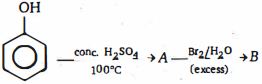
Identify the end product $(B)$ of the following sequence of reactions.
Rate constant for a reaction ${H_2} + {I_2} \to 2HI$ is $49$, then rate constant for reaction $2HI \to {H_2} + {I_2}$ is
Which of the following compounds will give silver mirror with ammoniacal silver nitrate?

($A$) Formic acid

($B$) Formaldehyde

($C$) Benzaldehyde

($D$) Acetone

Choose the correct answer from the options given below :

Assertion  : Aniline does not undergo Friedel- Crafts reaction.
Reason  : $-NH_2$ group of aniline reacts with $AlCl_3$ (Lewis acid) to give acid-base reaction
$STATEMENT-1$: Bromobenzene upon reaction with $\mathrm{Br}_2 / \mathrm{Fe}$ gives $1,4$ -dibromobenzene as the major product. and

$STATEMENT-2$: In bromobenzene, the inductive effect of the bromo group is more dominant than the mesomeric effect in directing the incoming electrophile.

Which one of the following hydrides is least stable
Conc. ${H_2}S{O_4}$ reacts with ${C_2}{H_5}OH$ at ${170\,^o}C$ to form
For a chemical reaction $Y + 2Z \to $ Product, rate controlling step is $Y\, + \frac{1}{2}Z\, \to Q$  If the concentration of $Z$ is doubled, the rate of reaction will