- $\alpha-\text{rays}$
- $\beta^+-\text{rays}$
- $\beta^--\text{rays}$
- $\gamma-\text{rays}$
Explanation:
Magnetic force acts on a charged particle, due to which it deflects from its path. The magnitude of this force is measured as $\Big|\overrightarrow{\text{F}}\Big|=\Big|\text{q}\Big(\overrightarrow{\text{v}}\times\overrightarrow{\text{B}}\Big)\Big|.$
Here, q is the charge on the particle that is moving with speed v in a uniform magnetic field B.
Since alpha, beta-plus and beta-minus are charged particles, they suffer deflection due to the field applied. On the other hand, gamma rays are photons and due to zero charge, they do not suffer any deflection.
Generate a complete, print-ready paper with questions like this in minutes — across 16+ boards, with answer keys.
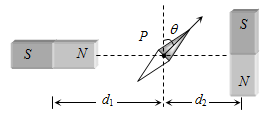
Two magnets A and B are identical and these are arranged as shown in the figure. Their length is negligible in comparison to the separation between them. A magnetic needle is placed between the magnets at point P which gets deflected through an angle θ under the influence of magnets. The ratio of distance
and
will be

|
(a) |
(b) |
(c) |
(d) |
The phenomenon utilised in an optical fibre is
|
(a) Refraction |
(b) Interference |
|
(c) Polarization |
(d) Total internal reflection |

A solenoid of 1.5 metre length and 4.0 cm diameter posses 10 turn per cm. A current of 5 ampere is flowing through it. The magnetic induction at axis inside the solenoid is
|
(a) 2π |
(b) 2π |
(c) 4π |
(d) 2π |
What is the difference between soft and hard X-rays
|
(a) Velocity |
(b) Intensity |
(c) Frequency |
(d) Polarization |
Two magnets A and B are identical in mass, length and breadth but have different magnetic moments. In a vibration magnetometer, if the time period of B is twice the time period of A. The ratio of the magnetic moments
of the magnets will be
| (a) 1/2 | (b) 2 | (c) 4 | (d) 1/4 |
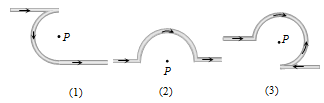
The magnetic field at the centre of a circular coil of radius r is π times that due to a long straight wire at a distance r from it, for equal currents. Figure here shows three cases : in all cases the circular part has radius r and straight ones are infinitely long. For same current the B field at the centre P in cases 1, 2, 3 have the ratio

|
(a) |
(b) |
|
(c) - |
(d) |