MCQ
Magnetic lines of force:
  • A
    Are mere directions.
  • B
    Have no physical reality.
  • C
    Can be used to indicate the direction of the magnetic field at point.
  • All the above are correct.

Answer

Correct option: D.
All the above are correct.
A pictorial representation of magnetic lines of force is very useful in visualizing the strength and direction of the magnetic field. The direction of magnetic lines of force is defined to be the direction in which the north end of a compass needle points. They have no physical existence.

Need a full question paper?

Generate a complete, print-ready paper with questions like this in minutes — across 16+ boards, with answer keys.
Start Generating Free

Similar questions

If focal length of the objective lens is increased, then
The angle of polarisation for any medium is $60^{\circ}$, what will be critical angle for this
The minimum frequency $\nu $ of continuous $X-$ rays is related to the applied potential difference $V$ as
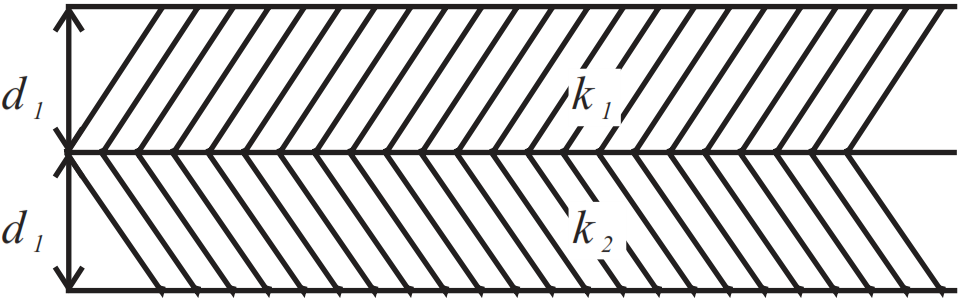
A parallel plate capacitor is made of two dielectric blocks in series. One of the blocks has thickness $d_1$ and dielectric constant $k_1$ and the other has thickness $d_2$ and dielectric constant $k_2$ as shown in Fig.

This arrangement can be thought as a dielectric slab of thickness $d (= d_1 + d_2)$ and effective dielectric constant $k$. The k is
Two parallel infinite line charges with linear charge densities $+\lambda\; \mathrm{C} / \mathrm{m}$ and $-\lambda\; \mathrm{C} / \mathrm{m}$ are placed at a distance of $2 \mathrm{R}$ in free space. What is the electric field mid-way between the two line charges?
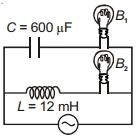
In the circuit shown in figure, if both the bulbs $B_1$ and $B_2$ are identical then
A $50\, W$ bulb is in series with a room heater and the combination is connected across the mains. To get max. heater output the $50\, W$ bulb should be replaced by ......$W$
In which of the following series, does the $121.5\ nm$ line of the spectrum of the hydrogen atom lie?
Image of an object approaching a convex mirror of radius of curvature $20\  m$ along its optical axis is observed to move from $\frac{{25}}{3}\ m$ to $\frac{{25}}{3}\ m$ in $30\  seconds$. What is the speed of the object in $km$ per hour ?
A capacitor stores $60\ \mu C$ charge when connected across a battery. When the gap between the plates is filled with a dielectric , a charge of $120\ \mu C$ flows through the battery. The dielectric constant of the material inserted is :