Question
Magnetic properties of coordination compounds. Explain in detail.

Answer

self

Need a full question paper?

Generate a complete, print-ready paper with questions like this in minutes — across 16+ boards, with answer keys.

Start Generating Free

Similar questions

  1. Account for the following:
  1. Transition metals show variable oxidation states.
  2. $Zn, Cd$ and $Hg$ are soft metals.
  3. $E^o$ value for the $Mn^{3+}/Mn^{2+}$ couple is highly
positive $(+ 1·57\ V)$ as compared to $Cr^{3+}/Cr^{2+}.$
  1. Write one similarity and one difference between the chemistry of lanthanoid and actinoid elements.
Answer the following question:
0.6mL of acetic acid $(CH_3COOH)$, having density $1.06g mL^{-1}$​​​​​​​, is dissolved in $1$ litre of water. The depression in freezing point observed for this strength of acid was $0.0205^\circ C$. Calculate the van’t Hoff factor and the dissociation constant of acid.
Match the coordination compounds given in Column I with the central metal atoms given in Column II and assign the correct code:
 
Column I (Coordination Compound)
 
Column II (Central metal atom)
a.
Chlorophyll
1.
Rhodium
b.
Blood pigment
2.
Cobalt
c.
Wilkinson catalyst
3.
Calcium
d.
Vitamin $B_{12}$
4.
Iron
 
 
5.
Magnesium
Code:
  1. A (5), B (4), C (1), D (2).
  2. A (3), B (4), C (5), D (1).
  3. A (4), B (3), C (2), D (1).
  4. A (3), B (4), C (1), D (2).
I. Show how p-aminoazobenzene can be obtained from aniline.
II. Write structures for the following compounds:
   a. Benzene diazonium chloride
   b. p-Nitrotoluene
   c. Sulphanilic acid
Match the terms given in Column I with the units given in Column II.
 
Column I
 
Column II
i.
$∧_m$
a.
$S cm^{-1}$
ii.
$E_{Cell}$
b.
$m^-$
iii.
$K$
c.
$S cm^2 mol^{-1}$
iv.
$G^*$
d.
$V$
A colourless substance 'A' $(C_6H_7N)$ is sparingly soluble in water and gives a water soluble compound 'B' on treating with mineral acid. On reacting with $CHCl_3$ and alcoholic potash 'A' produces an obnoxious smell due to the formation of compound 'C'. Reaction of 'A' with benzenesulphonyl chloride gives compound 'D' which is soluble in alkali. With $NaNO_2$ and HCl, 'A' forms compound 'E' which reacts with phenol in alkaline medium to give an orange dye 'F'. Identify compounds 'A' to 'F'.
$(i).$ Illustrate the following reactions giving suitable example in each case:
$a.$ Ammonolysis
$b.$ Coupling reaction
$c.$ Acetylation of amines
$(ii).$ Describe Hinsberg method for the identification of primary, secondary and tertiary amines. Also, write the chemical equations of the reactions involved.
Explain the relationship between basicity and structure of amines.

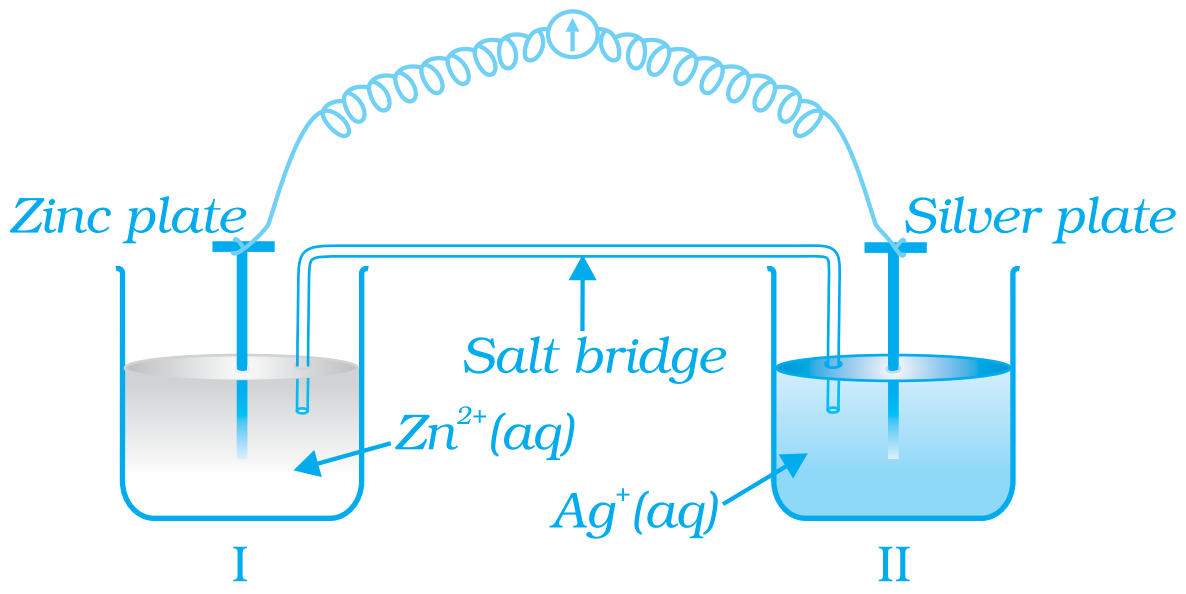
Consider and answer the questions (i) to (vi) given below.
  1. Redraw the diagram to show the direction of electron flow.
  2. Is silver plate the anode or cathode?
  3. What will happen if salt bridge is removed?
  4. When will the cell stop functioning?
  5. How will concentration of $Zn^{2+}$^ ions and $Ag^+$^ ions be affected when the cell functions?
  6. How will the concentration of$ Zn^{2+}$^ ions and $Ag^+$^ ions be affected after the cell becomes ‘dead’?
$i. \text{IUPAC} $ Write structures of different isomeric amines corresponding to the molecular formula, $C_4H_{11}N.$
$ii.$ Write $ \text{IUPAC} $ names of all the isomers.
$iii.$ What type of isomerism is exhibited by different pairs of amines?