MCQ
Main reason for brown ring test of $NO_3^-$ is
  • A
    Negligible tendency of $FeSO_4$ to form complex
  • Reducing power of $FeSO_4$ to convert $NO_3^-$ to $NO$
  • C
    Decomposition of $FeSO_4$ to give $SO_2$ gas
  • D
    Oxidising property of $FeSO_4$

Answer

Correct option: B.
Reducing power of $FeSO_4$ to convert $NO_3^-$ to $NO$
b

Need a full question paper?

Generate a complete, print-ready paper with questions like this in minutes — across 16+ boards, with answer keys.

Start Generating Free

Similar questions

Functional group present in sulphonic acid is:
In a reaction,

reagents ' $X$ ' and ' $Y$ ' respectively are:

$Emf$ of the following cell at $298 \,K$ in $V$ is $x \times 10^{-2} . Zn \left| Zn ^{2+}(0.1\, M ) \| Ag ^{+}(0.01 \,M )\right| Ag$ The value of $x$ is .... .

(Rounded off to the nearest integer)

[Given $: E_{Z n^{+2}/Z_{n}}^{0}=-0.76 \,V ; E _{A g^{+} / A_{ g }}^{0}=+0.80 \,V ; \frac{2.303 RT }{ F }=0.059$]

In which of the following sets, all the given species are isostructural ?
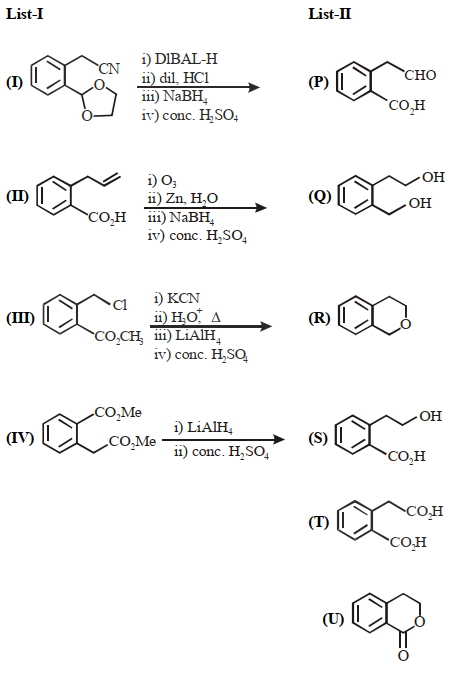
Answer the following by appropriately matching the lists based on the information given in the paragraph $List-I$ includess starting materials and reagents of selected chemical reactions. $List-II$ gives structures of compounds that may be formed as intermediate products and/or final products from the reactions of $List-I$

($1$) Which of the following options has correct combination considering $List-I$ and $List-II$?

$(1) (III), (S), (R)$ $(2) (IV), (Q), (R)$ $(3) (III), (T), (U)$ $(4) (IV), (Q), (U)$

($2$) Which of the following options has correct combination considering $List-I$ and $List-II$?

$(1) (I), (Q), (T), (U)$ $(2) (II), (P), (S), (U)$ $(3) (II), (P), (S), (T)$ $(4) (I), (S), (Q), (R)$

Give the answer quetion ($1$) and ($2$)
$2\, g$ of hydrogen combine with $16\, g$ of oxygen to form water and with $6\, g$ of carbon to form methane. In carbon dioxide $12\, g$ of carbon are combined with $32 \,g$ of oxygen. These figures illustrate the law of
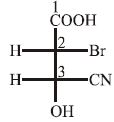
The absolute configurations of the two centers in the following molecule are
The numbers of sigma ($\sigma $) bonds in $ 1-$butene is
The number of unpaired electrons in the complex ion ${[Co{F_6}]^{3 - }}$ is (Atomic no. of $Co = 27)$
When chlorine is passed over dry slaked lime at room temperature, the main reaction product is