MCQ
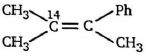
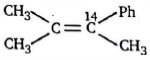
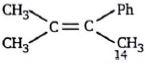
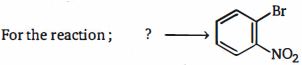
Major product of the reaction is :
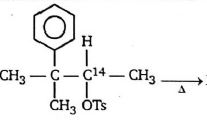
  • A

  • B
    $\begin{matrix}
       Ph\,\,\,\,\,\,\,\,\,\,\,\,\,\,\,  \\
       |\,\,\,\,\,\,\,\,\,\,\,\,\,\,\,\,\,\,  \\
       C{{H}_{3}}-C-\overset{14}{\mathop{C}}\,H=C{{H}_{2}}  \\
       |\,\,\,\,\,\,\,\,\,\,\,\,\,\,\,\,\,\,\,  \\
       C{{H}_{3}}\,\,\,\,\,\,\,\,\,\,\,\,\,\,  \\
    \end{matrix}$

  • D

Answer

Correct option: C.

c

Need a full question paper?

Generate a complete, print-ready paper with questions like this in minutes — across 16+ boards, with answer keys.

Start Generating Free

Similar questions

The reaction of $4$ -bromobenzyl chloride with sodium cyanide in ethanol leads  to the formation of
Given below are two statements, one is labelled as Assertion $A$ and the other is labelled as Reason $R$.

Assertion $A$ : $\left[ CoCl \left( NH _3\right)_5\right]^{2+}$ absorbs at lower wavelength of light with respect to $\left[ Co \left( NH _3\right)_5\left( H _2 O \right)\right]^{3+}$

Reason $R$ : It is because the wavelength of the light absorbed depends on the oxidation state of the metal ion.

In the light of the above statements, choose the correct answer from the options given below :

$C_6H_6$ $+$  $CH_3-CH=CH_2$ $\xrightarrow{{{H_3}P{O_4}}}A\,\xrightarrow[{heat}]{{{O_2}}}B\xrightarrow{{dil\,.\,{H_2}S{O_4}}}C + D$

$A, \,C$ and $D$ are

An organic compound $\left( C _8 H _{10} O _2\right)$ rotates plane-polarized light. It produces pink color with neutral $FeCl _3$ solution. What is the total number of all the possible isomers for this compound?
For an octahedral complex, which of the following $d-$ electronic configuration will give maximum magnitude of crystal field stabilisation energy, in terms of ${\Delta _0}$
The maximum and minimum $m.p.$ of $1^{st}$ transition and $2^{nd}$ transition series respectively are obtained with
In the following sequence of reactionsThe product  $C$ is

$C{H_3}C{H_2}C{H_2}Br\xrightarrow{{KOH(alc)}}(A)\xrightarrow{{HBr}}(B)\xrightarrow{{KOH\,(aq.)}}(C),$

; the best combination of reactants is
The reaction of ozone with oxygen atoms in the presence of chlorine atoms can occur by a two step process shown below

${O_3}(g)\, + \,C{l^ * }(g)\, \to \,{O_2}(g) + Cl{O^ * }(g)$ ..... $(i)$               $[{K_i} = 5.2 \times {10^9}\,\,L\,mo{l^{ - 1}}\,{s^{ - 1}}]$

$Cl{O^ * }(g) + {O^ * }(g)\, \to \,{O_2}(g) + \,C{l^ * }(g)$ ..... $(ii)$                $[{K_{ii}} = 2.6 \times {10^{10}}\,\,L\,mo{l^{ - 1}}\,{s^{ - 1}}]$

The closest rate constant for the overall reaction 

${O_3}(g){\mkern 1mu}  + {\mkern 1mu} {O^*}(g){\mkern 1mu}  \to {\mkern 1mu} 2{O_2}(g)$ is  ........... $L\,\,mo{l^{ - 1}}\,{s^{ - 1}}$

$8\,g$ of $NaOH$ is dissolved in $18\,g$ of $H_2O.$ Mole fraction of $NaOH$ in solution and molality (in $mol\,kg^{-1}$ ) of the solution respectively are