Question
Make $R$ the subject of formula $A=P\left(1+\frac{R}{100}\right)^N$

Answer

$A=P\left(1+\frac{R}{100}\right)^N $
$\Rightarrow \frac{A}{P}=\left(1+\frac{R}{100}\right)^N$
Taking $N$ the root both sides
$\Rightarrow\left(\frac{A}{P}\right)^{\frac{1}{N}}=\left(1+\frac{R}{100}\right) $
$\Rightarrow\left(\frac{A}{P}\right)^{\frac{1}{N}}-1=\frac{R}{100} $
$\Rightarrow 100\left(\left(\frac{A}{P}\right)^{\frac{1}{N}}-1\right)=R $
$\Rightarrow R=100\left(\sqrt[N]{\frac{A}{P}}-1\right) .$

Need a full question paper?

Generate a complete, print-ready paper with questions like this in minutes — across 16+ boards, with answer keys.

Start Generating Free

Similar questions

Kamal and Anand each lent the same sum of money for $2$ years at $5\%$ at simple interest and compound interst respectively. Anand recived $Rs. 15$ more than Kamal. Find the amount of money lent by each and the interest received.
The weights in grams of 50 apples picked at random from a consignment are as follows : 131, 113, 82, 75, 204, 81, 84, 118, 104, 110, 80, 107, 111, 141, 136, 123, 90, 78, 90, 115, 110, 98, 106, 99, 107, 84, 76, 186, 82, 100, 109, 128, 115, 107, 115, 119, 93, 187, 139, 129, 130, 68, 195, 123, 125, 111, 92, 86, 70, 126
Form the grouped frequency table by dividing the variable range into intervals of equ width of 20 g.
A $12\ liter$ solution is $33 \frac{1}{3} \%$ acid. How much water must be added to get the solution having $20 \%$ acid?
$AD$ is altitude of an isosceles triangle $\text{ABC}$ in which $AB = AC = 30 \ cm$ and $BC = 36 \ cm.$ A point $O$ is marked on $AD$ in such a way that $\angle BOC = 90^\circ.$ Find the area of quadrilateral $\text{ABOC}.$
Simplify the following$\frac{\sqrt{5}-2}{\sqrt{5}+2}-\frac{\sqrt{5}+2}{\sqrt{5}-2}$
Find $AB$ and $BC,$ if:
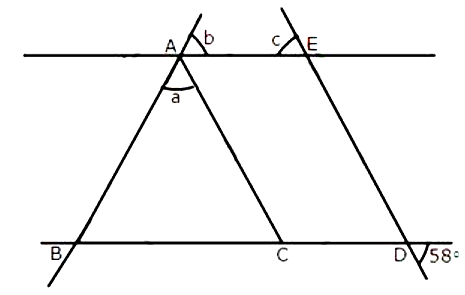
In the given figure; $A E\|B D, A C\| E D$ and $A B=A C$. Find $\angle a , \angle b$ and $\angle C$.
Write the following in ascending order:$7 \sqrt[3]{5}, 6 \sqrt[3]{4}$ and $5 \sqrt[3]{6}$
In $\triangle ABC, D$ and $E$ are the mid$-$point on $AB$ and $AC$ such that $DE \| BC$.If $AD : BD = 4 : 5$ and $EC = 2.5 \ cm$, find $AE.$
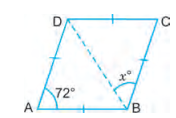
In the given figure, ABCD is a rhombus in which $\angle A =72^{\circ}$. If $\angle CBD =x^{\circ}$, find the value of $x$.
Image