MCQ
Many elements have non-integral atomic masses because :
- AThey have isotopes
- BTheir isotopes have non-integral masses
- CTheir isotopes have different masses
- ✓The constituents neutrons, protons and electrons combine to give fractional masses
Eg. $Cl ; z =17$ and $A =35$ and $37$. They are present in the ratio $3: 1$.
$\therefore \frac{3 \times 35+1 \times 37}{4}=35.5( A )$
Generate a complete, print-ready paper with questions like this in minutes — across 16+ boards, with answer keys.
$(R= 8.314\,\,JK^{-1}\,\,mol^{-1};\,\,ln\,2 = 0.693;\,\,ln\,3 = 1.098)$
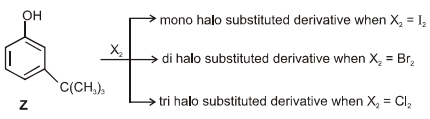
$Image$
The observed pattern of electrophilic substitution can be explained by
$(A)$ the steric effect of the halogen
$(B)$ the steric effect of the tert-butyl group
$(C)$ the electronic effect of the phenolic group
$(D)$ the electronic effect of the tert-butyl group