Question
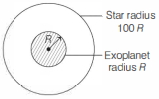
Many exoplanets have been discovered by the transit method, where in one monitors, a dip in the intensity of the parent star as the exoplanet moves in front of it. The exoplanet has a radius $R$ and the parent star has radius $100 \,R$. If $I_0$ is the intensity observed on earth due to the parent star, then as the exoplanet transits
Answer

(d)

Intensity of radiation (mainly visible light) emitted from surface of a star is proportional to its area.

So, $\quad I \propto A$ or $I=k A$

where, $k=$ constant.

Now, if $I_0=$ intensity of parent star.

Then, $I_0=k \pi(100 R)^2=k \pi R^2 \times 10000$

When exoplanet is in front of star,

observed intensity will be minimum. Let intensity minimum is $I_{\min }$, then

$I_{\min }=k\left[\pi(100 R)^2-\pi R^2\right]$

$\Rightarrow I_{\min } =k \pi R^2(10000-1)$

$=k \pi R^2 \times 9999$

$\text { So, } \frac{I_{min}}{I_0} =\frac{k \pi R^2 \times 9999}{k \pi R^2 \times 10000}$

$\Rightarrow I_{\min }=I_0 \times 0.9999$

Need a full question paper?

Generate a complete, print-ready paper with questions like this in minutes — across 16+ boards, with answer keys.

Start Generating Free

Similar questions

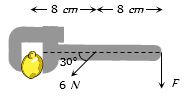
When a force of $6.0 \,N $ is exerted at ${30^o}$ to a wrench at a distance of $8 \,cm $ from the nut, it is just able to loosen the nut. What force $F$ would be sufficient to loosen it, if it acts perpendicularly to the wrench at $16\, cm$ from the nut ....... $N$
In a cyclotron experiment, if we assume that maximum radius attained by any charged particle is equal to radius of dees, then minimum kinetic energy gained by the particles will be for
The number of lenses in a terrestrial telescope is
Which statements are correct about degrees of freedom?

$A.$ $A$ molecule with $n$ degrees of freedom has $n^{2}$ different ways of storing energy.

$B.$ Each degree of freedom is associated with $\frac{1}{2} RT$ average energy per mole.

$C.$ $A$ monoatomic gas molecule has $1$ rotational degree of freedom where as diatomic molecule has $2$ rotational degrees of freedom

$D$ $CH _{4}$ has a total to $6$ degrees of freedom Choose the correct answer from the option given below:

Five similar condenser plates, each of area $A$, are placed at equal distance apart and are  connected to a source of $e.m.f.$ $V$ as shown in the following diagram. The charge on the  plates $1$ and $4$ will be:-
When a body slides down from rest along a smooth inclined plane making an angle of $30^{\circ}$ with the horizontal, it takes time $T$. When the same body slides down from the rest along a rough inclined plane making the same angle and through the same distance, it takes time $\alpha {T}$, where $\alpha$ is a constant greater than $1 .$ The co-efficient of friction between the body and the rough plane is $\frac{1}{\sqrt{{x}}}\left(\frac{\alpha^{2}-1}{\alpha^{2}}\right)$ where ${x}=..... .$
An object is placed $20\, cm$ in front of a $4\, cm$ thick plane mirror. The image of the object finally is formed at $45\, cm $ from the object itself . The refractive index of the material of the unpolished side of the mirror is (considering near normal incidence)
The resistance of a wire is $R$. It is bent at the middle by $180^{\circ}$ and both the ends are twisted together to make a shorter wire. The resistance of the new wire is
With rise in temperature, the Young's modulus of elasticity
Using a nuclear counter the count rate of emitted particles from a radioactive source is measured. At $t = 0$ it was $1600$ counts per second and $t = 8\, seconds$ it was $100$ counts per second. The count rate observed, as counts per second, at $t = 6\, seconds$ is close to