Question
Mark the correct alternative in the following question:
Suppose a random variable X follows the binomial distribution with parameters n and p, where 0 < p < 1. If $\frac{\text{P(X = r})}{\text{P(X = n} -\text{r})}$ is independent of n and r, then p equals:
  1. $\frac{1}{2}$
  2. $\frac{1}{3}$
  3. $\frac{1}{5}$
  4. $\frac{1}{7}$

Answer

  1. $\frac{1}{2}$
Solution:
Consider,
$\text{P(X = r) = kP(X = n}-\text{r})$
Using $\text{ }^{\text{n}}\text{C}_{\text{r}}=\text{ }^{\text{n}}\text{C}_{\text{n}-\text{r}},\text{q}=1-\text{p}$
$\text{p}^{\text{r}}\text{q}^{\text{n}-\text{r}}=\text{kp}^{\text{n}-\text{r}}\text{q}^{\text{r}}$
$\text{p}^{\text{r}}(1-\text{p})^{\text{n}-\text{r}}=\text{kp}^{\text{n}-\text{r}}(1-\text{p})^{\text{r}}$
$\text{p}^{2\text{r}-\text{n}}=\text{k}(1-\text{p})^{\text{2r}-\text{n}}$
$\big(\frac{\text{p}}{\text{q}}\big)^{\text{2r}-\text{n}}=\text{k}$
when p = q then k = 1
$\Rightarrow\text{p = q}=\frac{1}{2}$

Need a full question paper?

Generate a complete, print-ready paper with questions like this in minutes — across 16+ boards, with answer keys.

Start Generating Free

Similar questions

If $A$ is a square matrix such that $A^2 = A,$ then $(I - A)^3 + A$ is equal to:
The locus of xy + yz = 0 is:
  1. A pair of st. lines
  2. A pair of parallel lines
  3. A pair of parallel planes
  4. A pair of perpendicular planes
If $\text{g(f(x))}=|\sin\text{x}|$ and $\text{f(g(x))}=(\sin\sqrt{\text{x}})^2,$ then
  1. $\text{f(x)}=\sin^2\text{x},\ \text{g(x)}=\sqrt{\text{x}}$
  2. $\text{f(x)}=\sin\text{x},\ \text{g(x)}=|\text{x}|$
  3. $\text{f(x)}=\text{x}^2,\ \text{g(x)}=\sin\sqrt{\text{x}}$
  4. $\text{f and g cannot be determined.}$
If the sum of the matrices $\begin{bmatrix}\text{x}\\\text{x}\\\text{y}\end{bmatrix},\begin{bmatrix}\text{x}\\\text{y}\\\text{z}\end{bmatrix}$ and $\begin{bmatrix}\text{z}\\0\\0\end{bmatrix}$ is the matrix $\begin{bmatrix}10\\5\\5\end{bmatrix},$ then what is the value of y ?
  1. -5
  2. 0
  3. 5
  4. 10
For non-zero vectors $\vec{\text{a}},\vec{\text{b}}$ and $\vec{\text{c}}$ the relation $\big|\big(\vec{\text{a}}\times\vec{\text{b}}\big).\vec{\text{c}}\big|=\big|\vec{\text{a}}\big|\big|\vec{\text{b}}\big|\big|\vec{\text{c}}\big|$ holds good, if:
  1. $\vec{\text{a}}.\vec{\text{b}}=\vec{\text{b}}.\vec{\text{c}}=0$
  2. $\vec{\text{a}}.\vec{\text{b}}=0=\vec{\text{c}}.\vec{\text{a}}$
  3. $\vec{\text{a}}.\vec{\text{b}}=\vec{\text{b}}.\vec{\text{c}}=\vec{\text{c}}.\vec{\text{a}}=0$
  4. $\vec{\text{b}}.\vec{\text{c}}=\vec{\text{c}}.\vec{\text{a}}=0$
The degree of the differential equation $\left(\frac{d^2 y}{d x^2}\right)^{2 / 3}+4-3 \frac{d y}{d x}=0$ is
The radius of a circle is increasing at the rate of 0.4 cm/ s. The rate of increasing of its circumference is:
  1. $0.4\pi\text{cm}/\text{ s}.$
  2. $0.8\pi\text{cm}/\text{ s}.$
  3. $0.8\text{cm}/\text{ s}.$
  4. $\text{None of these}$
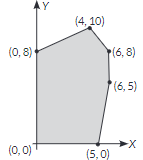
In the given graph, the feasible region for a LPP is shaded. The objective function $Z=2 x-3 y$, will be minimum at
Image
Let R be a relation on N defined by x + 2y = 8. The domain of R is:
  1. {2, 4, 8}
  2. {2, 4, 6, 8}
  3. {2, 4, 6}
  4. {1, 2, 3, 4}
Suppose $X =\left\{x^2, x \in N\right\}$ and $f: N \rightarrow X$ defined such that $f(x)=x^2, x \in N$ then function is: