MCQ
Mark the correct options:
  • A
    If the incident rays are converging, we have a real object.
  • If the final rays are converging, we have a real image.
  • C
    The image of a virtual object is called a virtual image.
  • D
    If the image is virtual, the corresponding object is called a virtual object.
Answer

Correct option: B.
If the final rays are converging, we have a real image.
This is because a real image is formed by converging reflected/ refracted rays from a mirror/ lens.

Need a full question paper?

Generate a complete, print-ready paper with questions like this in minutes — across 16+ boards, with answer keys.

Start Generating Free

Similar questions

A tunning fork produces $5\, beats/sec$ when the length of a sonometer wire is either $1\, m$ or $1.05\, m$. Calculate the frequency of tunning fork  .... $Hz$
If wavelengths of maximum intensity of radiations emitted by the sun and the moon are $0.5 \times {10^{ - 6}}m$ and ${10^{ - 4}}m$ respectively, the ratio of their temperatures is
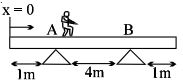
$A$ man can move on a horizontal plank supported symmetrically as shown. The variation of normal reaction on support $A$ with distance $x$ of the man from the end of the plank is best represented by :
Which of the following vehicles is undergoing a deacceleration?
When a body is in the state of complete rest, what kind of energy does it possess?
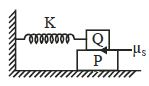
A block $P$ of mass $m$ is placed on a smooth horizontal surface. A block $Q$ of same mass is placed over the block $P$ and the coefficient of static friction between them is ${\mu _S}$. A spring of spring constant $K$ is attached to block $Q$. The blocks are displaced together to a distance $A$ and released. The upper block oscillates without slipping over the lower block. The maximum frictional force between the block is
If the current in the circuit for heating the filament is increased, the cutoff wavelength:
A uniform circular disc of mass $50 \ kg$ and radius $0.4 \ m$ is rotating with an angular velocity of $10 \ rad / s ^{-1}$ about its own axis, which is vertical. Two uniform circular rings, each of mass $6.25 \ kg$ and radius $0.2 \ m$, are gently placed symmetrically on the disc in such a manner that they are touching each other along the axis of the disc and are horizontal. Assume that the friction is large enough such that the rings are at rest relative to the disc and the system rotates about the original axis. The new angular velocity (in $rad s ^{-1}$ ) of the system is :
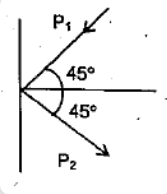
A ball moving with a momentum of $5\ \ce{kgm/ s}$ strikes against a wall at an angle of $45^\circ$ and is reflected at the same angle. The change in momentum will be $\ce{(kg-m/ s):}$​​​​​​​
If the momentum of a body is increased $n$ times, its kinetic energy increases