MCQ
Mark the oxide which is amphoteric in character
  • A
    $C{O_2}$
  • B
    $Si{O_2}$
  • $Sn{O_2}$
  • D
    $Ca{O_{}}$

Answer

Correct option: C.
$Sn{O_2}$
c
(c) $Sn{O_2} + 2NaOH \to N{a_2}Sn{O_3} + {H_2}O$

$Sn{O_2} + 4HCl \to SnC{l_4} + 2{H_2}O$

Need a full question paper?

Generate a complete, print-ready paper with questions like this in minutes — across 16+ boards, with answer keys.
Start Generating Free

Similar questions

When a certain conductivity cell was filled with $0.1\ M\  KCl$, it had a resistance of $85\  \Omega$ at $25\,^o\ C$. When the same cell was filled with an aqueous solution of $0.052\  M$ unknown electrolyte, the resistance was $96\  \Omega$. Calculate the molar conductivity of the unknown electrolyte at this concentration ............ ${\Omega ^{ - 1}}{\rm{c}}{{\rm{m}}^2}{\rm{mo}}{{\rm{l}}^{ - 1}}$ (Given : Specific conductivity of $0.1\ M\  KCl = 1.29 × 10^{-2}\ \Omega ^{-1} \ \ cm^{-1}$)
Which of the following complexes have a maximum number of unpaired electrons?
The number of geometrical isomers found in the metal complexes $[PtCl \left._{2}\left(\mathrm{NH}_{3}\right)_{2}\right],\left[\mathrm{Ni}(\mathrm{CO})_{4}\right]$, $\left[\mathrm{Ru}\left(\mathrm{H}_{2} \mathrm{O}\right)_{3} \mathrm{Cl}_{3}\right]$ and $\left[\mathrm{CoCl}_{2}\left(\mathrm{NH}_{3}\right)_{4}\right]^{+}$ respectively, are :
$HBr$ and $HI$ can reduce ${H_2}S{O_4},\,\,HCl$ can reduce $KMn{O_4}$ and $HF$ can reduce
A reversible reaction ${H_2} + C{l_2}$ $\rightleftharpoons$ $2HCl$ is carries out in one litre flask. If the same reaction is carried out in two litre flask, the equilibrium constant will be
Choose the correct statement $(s)$
The ionic conductance of following cation in a given concentration are in the order
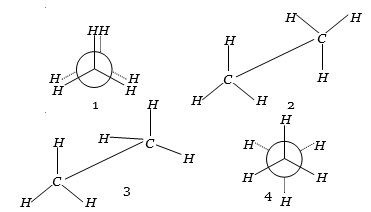
Which are the staggered forms of ethane
The number of moles of $\mathrm{NH}_{3}$, that must be added to $2 \,\mathrm{~L}$ of $0.80\, \mathrm{M}\, \mathrm{AgNO}_{3}$ in order to reduce the concentration of $\mathrm{Ag}^{+}$ions to $5.0 \times 10^{-8}\, \mathrm{M}\left(\mathrm{K}_{\text {formation }}\right.$ for $\left.\left[\mathrm{Ag}\left(\mathrm{NH}_{3}\right)_{2}\right]^{+}=1.0 \times 10^{8}\right)$ is ...... . (Nearest integer)

[Assume no volume change on adding $\mathrm{NH}_{3}$ ]

The electronic configuration of fluorine is