Question
Match Column I with Column II.
S. No Column I (Reaction) S. No Column II (Equilibrium constant)
1. $2\text{N}_2(\text{g})+6\text{H}_2(\text{g})\rightleftharpoons4\text{NH}_3(\text{g})$ (i) $2\text{K}_{\text{c}}$
2. $2\text{NH}_3(\text{g})\rightleftharpoons\text{N}_2(\text{g})+3\text{H}_2(\text{g})$ (ii) $\text{K}_{\text{c}}^{\frac{1}{2}}$
3. $\frac{1}{2}\text{N}_2\text{(g)}+\frac{3}{2}(\text{g})\rightleftharpoons\text{NH}_3(\text{g})$ (iii) $\frac{1}{\text{K}}$
4.   (iv) $\text{K}^2_{\text{c}}$

Answer

S. No Column I (Reaction) S. No Column II (Equilibrium constant)
1. $2\text{N}_2(\text{g})+6\text{H}_2(\text{g})\rightleftharpoons4\text{NH}_3(\text{g})$ (iv) $\text{K}^2_{\text{c}}$
2. $2\text{NH}_3(\text{g})\rightleftharpoons\text{N}_2(\text{g})+3\text{H}_2(\text{g})$ (iii) $\frac{1}{\text{K}}$
3. $\frac{1}{2}\text{N}_2\text{(g)}+\frac{3}{2}(\text{g})\rightleftharpoons\text{NH}_3(\text{g})$ (ii) $\text{K}_{\text{c}}^{\frac{1}{2}}$

Need a full question paper?

Generate a complete, print-ready paper with questions like this in minutes — across 16+ boards, with answer keys.

Start Generating Free

Similar questions

Using the equation of state pV = nRT; show that at a given temperature density of a gas is proportional to gas pressure p.
In terms of period and group where would you locate the element with $Z=114$?
  1. What are two conditions for the formation of hydrogen bond?
  2. In which of the following compounds 'S' does not obey octet rule?
$\text{SF}_2,\text{SF}_4,\text{SF}_6,\text{SO}_2$
  1. Explain the term hybridisation taking $\text{CH}\equiv\text{CH}$ as an example.
Neon gas is generally used in the sign boards. If it emits strongly at $616\ nm$, calculate
  1. The frequency of emission.
  2. Distance traveled by this radiation in $30s$.
  3. Energy of quantum.
  4. Number of quanta present if it produces $2J$ of energy.
Statues and monuments in India are affected by acid rain. How?
Give a brief description of the principles of the following techniques taking an example in each case.
Chromatography.
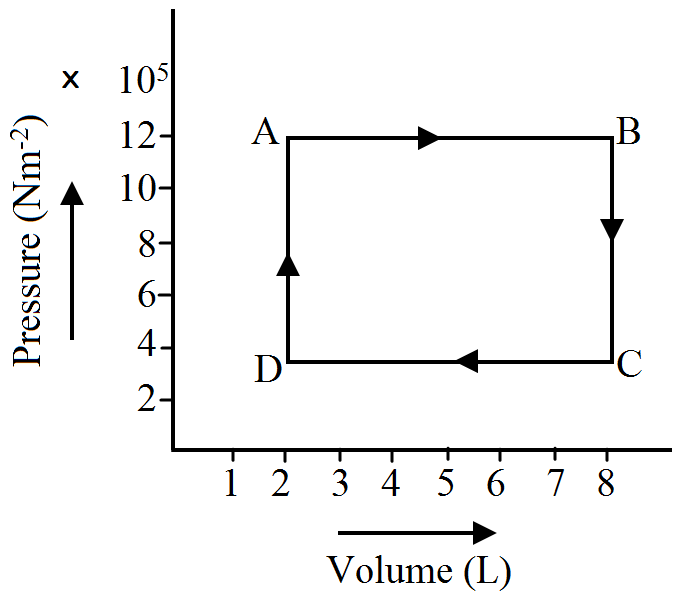
The figure given below represents pV diagram of different stages of a thermodynamic process. Calculate the work done in each stage and also the net work done in the complete cyclic process.
Among $\mathrm{NH}_3, \mathrm{H}_2 \mathrm{O}$ and HF , which would you expect to have highest magnitude of hydrogen bonding and why?
Explain why cation are smaller and anions larger in radii than their parent atoms?
A compound made up of two elements A and B has A = 70%, B = 30%. Their relative number of moles in the compound are $1.25$ and $1.88$. Calculate.
  1. Atomic masses of the elements A and B.
  2. Molecular formula of the compound, if its molecular mass is found to be 160.