MCQ
Match List $- I$ (Experiment performed) with List $-II$ (Phenomena discovered/associated) and select the correct option from the options given the lists
List $- I$ List $- II$
$(1)$ Davisson and Genner $(i)$ Wave nature of electrons
$(2)$ Millikan's oil drop experiment $(ii)$ Charge of an electron
$(3)$ Rutherford experiment $(iii)$ Quantisation of energy levels
$(4)$ Franck-Hertz experiment $(iv)$ Existence of nucleus
  • A
    $(1 )-(i), (2)-(ii), (3)-(iii), (4)-(iv)$
  • $(1 )-(i), (2)-(ii), (3)-(iv), ( 4)-(iii)$
  • C
    $(1)-(iii), (2)-(iv), (3)-(i), (4)-(ii)$
  • D
    $(1 )-(iv), (2-(iii), (3)-(ii), (4 )-(i)$
Answer

Correct option: B.
$(1 )-(i), (2)-(ii), (3)-(iv), ( 4)-(iii)$
b
$(1)$ Davisson and Gemner experiment-wave nature of electrons.
$(2)$ Millikan's oil drop experiment - charge of an electron.
$(3)$ Rutherford experiment - Existance of nucleus.
$(4)$ Frank-Hertz experiment - Quantisation of energy levels.

Need a full question paper?

Generate a complete, print-ready paper with questions like this in minutes — across 16+ boards, with answer keys.

Start Generating Free

Similar questions

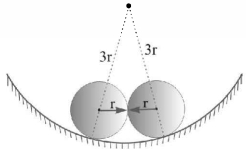
Two equal heavy spheres, each of radius $r$, are in equilibrium within a smooth cup of radius $3 r$. The ratio of reaction between the cup and one sphere and that between the two sphere is
A solid sphere and a hollow sphere of the same material and size are heated to the same temperature and allowed to cool in the same surroundings. If the temperature difference between each sphere and its surroundings is $T$, then
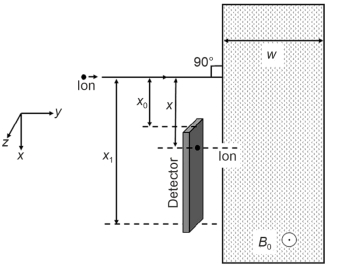
A positive, singly ionized atom of mass number $A_M$ is accelerated from rest by the voltage $192 V$. Thereafter, it enters a rectangular region of width $w$ with magnetic field $B_0=0.1 \hat{k}$ Tesla, as shown in the figure. The ion finally hits a detector at the distance $x$ below its starting trajectory.

[Given: Mass of neutron/proton $=(5 / 3) \times 10^{-27} kg$, charge of the electron $=1.6 \times 10^{-19} C$.]

Which of the following option($s$) is(are) correct?

$(A)$ The value of $x$ for $H^{+}$ion is $4 cm$.

$(B)$ The value of $x$ for an ion with $A_M=144$ is $48 cm$.

$(C)$ For detecting ions with $1 \leq A_M \leq 196$, the minimum height $\left(x_1-x_0\right)$ of the detector is $55 cm$.

$(D)$ The minimum width $w$ of the region of the magnetic field for detecting ions with $A_M=196$ is $56 cm$.

A charged particle of mass $m$ and charge $q$ travels on a circular path of radius $r$ that is perpendicular to a magnetic field $B$. The time taken by the particle to complete one revolution is
The distance between the two plates of a parallel plate capacitor is doubled and the area of each plate is halved. If $C$ is its initial capacitance, its final capacitance is equal to
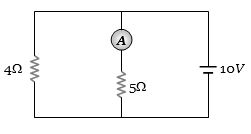
In the circuit, the reading of the ammeter is ................. $A$ (assume internal resistance of the battery be zero)
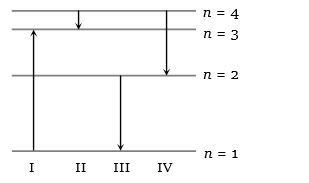
The diagram shows-the energy levels for an electron in a certain atom. Which transition shown represents the emission of a photon with the most energy
An experiment is performed to determine the $I-V$ characteristics of a Zener diode, which has a protective resistance of $R = 100 \,\Omega ,$ and a maximum power of dissipation rating of $1\,W$ .The minimum voltage range of the $DC$ source in the circuit is
The ratio of angular speeds of minute hand and hour hand of a watch is
A biconvex lens of focal length $15 \mathrm{~cm}$ is in front of a plane mirror. The distance between the lens and the mirror is $10 \mathrm{~cm}$. A small object is kept at a distance of $30 \mathrm{~cm}$ from the lens. The final image is