MCQ
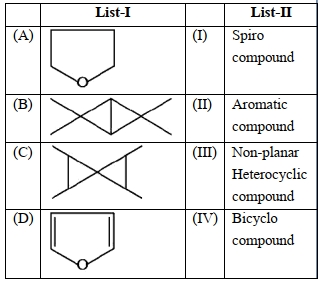
Match $List-I$ with $List-II$.

Choose the correct answer from the options given below.
  • A
    $( A )-( II ),( B )-( I ),( C )-( IV ),( D )-( III )$
  • B
    $(A) -( IV ),( B )-( III ),( C )-( I ),( D )-( II )$
  • $(A) -( III),(B)-(IV) ,(C)-(I),(D)-(II )$
  • D
    $(A) -(IV) ,( B )-( III ),( C )-( II ),( D )-( I )$
Answer

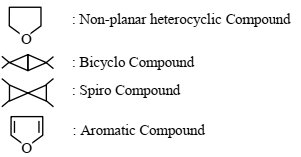
Correct option: C.
$(A) -( III),(B)-(IV) ,(C)-(I),(D)-(II )$
c

Need a full question paper?

Generate a complete, print-ready paper with questions like this in minutes — across 16+ boards, with answer keys.

Start Generating Free

Similar questions

In isolated system, find the condition for spontaneous reaction.
A chromatography column, packed with silica gel as stationary phase, was used to separate a mixture of compounds consisting of $(A)$ benzanilide $(B)$ aniline and $(C)$ acetophenone. When the column is eluted with a mixture of solvents, hexane: ethyl acetate $(20: 80),$ the sequence of obtained compounds
The angular momentum of an electron depends on
Consider a $70 \%$ efficient hydrogen-oxygen fuel cell working under standard conditions at 1 bar and $298 K$. Its cell reaction is

$H _2( g )+\frac{1}{2} O _2( g ) \rightarrow H _2 O (\ell)$

The work derived from the cell on the consumption of $1.0 \times 10^{-3} mol$ of $H _2( g )$ is used to compress $1.00 mol$ of a monoatomic ideal gas in a thermally insulted container. What is the change in the temperature (in $K$ ) of the ideal gas ?

The standard reduction potentials for the two half-cells are given below.

$\left. O _2( g )+4 H ^{+} \text {(aq. }\right)+4 e ^{-} \rightarrow 2 H _2 O (\ell), E ^{\circ}=1.23 V,$

$\left.2 H ^{+} \text {(aq. }\right)+2 e ^{-} \rightarrow H _2( g ), E ^{\circ}=0.00 V.$

Use $F =96500 C mol ^{-1}, R =8.314 J mol ^{-1} K ^{-1}$

Excited state of chlorine in $ClF_3$ is
The noble gas compound prepared by bartlett was
Correct match among the following are 

$(a) ClO_4^-> ClO_3^-> ClO_2^-> ClO^-$ Stability order

$(b) Cl_2 > Br_2> F_2> I_2$ Bond energy

$(c) OF_2 < OH_2< OCl_2$ Bond angle

$(d) I^-> Br^-> Cl^-$ Reducing power

Propane$-1-$ol can be prepared from propene by its reaction with
Arrange in their increasing order of equilibrium constants for hydration ?

$\underset{(A)}{\mathop{\begin{matrix}
   O  \\
   ||  \\
   C{{H}_{3}}-C-C{{H}_{3}},  \\
\end{matrix}}}\,\,\,\,\,\underset{(B)}{\mathop{\begin{matrix}
   \,\,\,\,\,\,O  \\
   \,\,\,\,\,\,||  \\
   C{{H}_{3}}-C-H,  \\
\end{matrix}}}\,\,\,\,\,\underset{(C)}{\mathop{\begin{matrix}
   O\,\,\,\,\,\,\,\,\,\,\,\,\,\,  \\
   ||\,\,\,\,\,\,\,\,\,\,\, \,\, \\
   C{{H}_{3}}-C-C{{H}_{2}}-Cl,  \\
\end{matrix}}}\,$ $\,\,\underset{(D)}{\mathop{\begin{matrix}
   O  \\
   ||  \\
   H-C-H,  \\
\end{matrix}}}\,\,\,\,\underset{(E)}{\mathop{\begin{matrix}
   \,\,\,\,\,\,\,\,\,\,\,\,\,\,\,\,\,\,\,\,O  \\
   \,\,\,\,\,\,\,\,\,\,\,\,\,\,\,\,\,\,\,\,||  \\
   Cl-C{{H}_{2}}-C-H  \\
\end{matrix}}}\,$

The standard e.m.f. of a call, involving one electron change is found to be $0.591\,V $ at $25\,^o C$. The equilibrium constant of the reaction is

($F = 96,500\;C\;mo{l^{ - 1}}; \,\, R = 8.314\;J{K^{ - 1}}mo{l^{ - 1}})$