MCQ
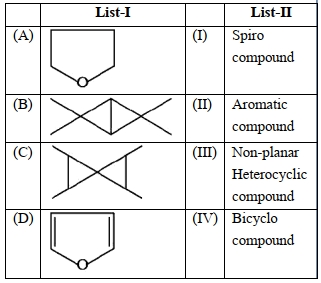
Match $List-I$ with $List-II$.

Choose the correct answer from the options given below.
  • A
    $( A )-( II ),( B )-( I ),( C )-( IV ),( D )-( III )$
  • B
    $(A) -( IV ),( B )-( III ),( C )-( I ),( D )-( II )$
  • $(A) -( III),(B)-(IV) ,(C)-(I),(D)-(II )$
  • D
    $(A) -(IV) ,( B )-( III ),( C )-( II ),( D )-( I )$
Answer

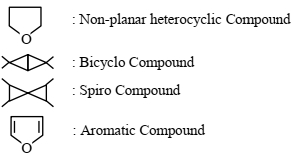
Correct option: C.
$(A) -( III),(B)-(IV) ,(C)-(I),(D)-(II )$
c

Need a full question paper?

Generate a complete, print-ready paper with questions like this in minutes — across 16+ boards, with answer keys.

Start Generating Free

Similar questions

Max. number of moles of electrons taken up by one mole of $NO_3^ - $ when it is reduced to
Assertion : Energy of resonance hybrid is equal to the average of energies of all canonical forms.

Reason : Resonance hybrid cannot be presented by a single structure.

Consider the following statements:

$(A)$ $NF _3$ molecule has a trigonal planar structure.

$(B)$ Bond length of $N _2$ is shorter than $O _2$.

$(C)$ Isoelectronic molecules or ions have identical bond order.

$(D)$ Dipole moment of $H _2 S$ is higher than that of water molecule.

Choose the correct answer from the option below:

The correct order of ionisation energy for comparing carbon, nitrogen and oxygen atoms is
Assertion : The radius of the first orbit of hydrogen atom is $0.529\,\mathop A\limits^o$
Reason : Radius of each circular orbit $(r_n) - 0.529\,\mathop A\limits^o  \,(n^2/Z),$ where $n = 1, 2, 3$ and $Z =$ atomic number.
Sodium oxide reacts with water to produce sodium hydroxide. $20.0\, \mathrm{~g}$ of sodium oxide is dissolved in $500\, \mathrm{~mL}$ of water. Neglecting the change in volume, the concentration of the resulting $\mathrm{NaOH}$ solution is $........\times \quad 10^{-1} \quad$ $M.$ (Nearest integer)

[Atomic mass $: \mathrm{Na}=23.0, \mathrm{O}=16.0, \mathrm{H}=1.0]$

The species having pyramidal shape is
The phenomenon of splitting of spectral lines under the influence of the electric field is called:
From the given species such as Li, K, Ca and Na, which of the following is the strongest reducing agent?
The alkene ${C_6}{H_{10}}$ producing $OHC - {(C{H_2})_4} - CHO$ on ozonolysis is