MCQ
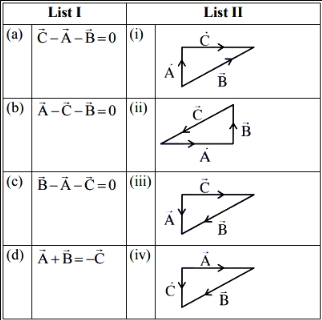
Match List$- I$ with List$- II.$

$[Image]$

Choose the correct answer from the options given below :
  • A
    $(a) \rightarrow(iv),(b) \rightarrow(i),(c) \rightarrow(i i i),(d) \rightarrow(i i)$
  • $(a) \rightarrow(iv),(b) \rightarrow(iii),(c) \rightarrow(i),(d) \rightarrow(ii)$
  • C
    $(a) \rightarrow(iii),(b) \rightarrow(ii),(c) \rightarrow(iv),(d) \rightarrow(i)$
  • D
    $(a) \rightarrow(i),(b) \rightarrow(iv),(c) \rightarrow(ii),(d) \rightarrow(iii)$
Answer

Correct option: B.
$(a) \rightarrow(iv),(b) \rightarrow(iii),(c) \rightarrow(i),(d) \rightarrow(ii)$
b

Need a full question paper?

Generate a complete, print-ready paper with questions like this in minutes — across 16+ boards, with answer keys.

Start Generating Free

Similar questions

The muon has the same charge as an electron but a mass that is $207$ times greater. The negatively charged muon can bind to a proton to form a new type of hydrogen atom. How does the binding energy $E_{Bμ}$ of the muon in the ground state of a muonic hydrogen atom  compare with the binding energy $E_{Be}$ of an electron in the ground state of a conventional hydrogen atom ?
The equation $y = 0.15\sin 5x\cos 300t$, describes a stationary wave. The wavelength of the stationary wave is .... $m$
When a bar magnet is freely suspended for oscillation then time period is $T$. If it is cut in $3$ equal parts perpendicular to its length then time period of oscillation for each part will be
A standing wave $y = A sin \left( {\frac{{20}}{3}\pi \,x} \right) cos (1000\pi t)$ is maintained in a taut string where y and $x$ are expressed in meters. The distance between the successive points oscillating with the amplitude $A/2$ across a node is equal to  ... $cm$
A flywheel has moment of inertia $4\ kg - {m^2}$ and has kinetic energy of $200\ J$. Calculate the number of revolutions it makes before coming to rest if a constant opposing couple of $5\ N - m$ is applied to the flywheel .......... $rev$
The characteristic $X-$ ray radiation is emitted, when
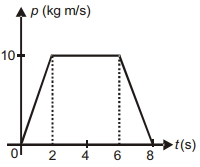
The momentum $p$ of an object varies with time $(t)$ as shown in figure. The corresponding force $(F)$-time $(t)$ graph is
In an experiment to verify Stokes law, a small spherical ball of radius $r$ and density $\rho$ falls under gravity through a distance $h$ in air before entering a tank of water. If the terminal velocity of the ball inside water is same as its velocity just before entering the water surface, then the value of $h$ is proportional to :

(ignore viscosity of air)

If the binding energy of the electron in a hydrogen atom is $13.6\, eV,$ the energy required to remove the electron from the first excited state of $L{i^{ + + }}$ is.....$eV$
The resultant magnetic moment of neon atom will be