MCQ
Match List $I$ with List $II$

LIST $I$ (Technique) LIST $II$ (Application)
$A$. Distillation $I$. Separation of glycerol from spent-lye
$B$. Fractional distillation $II$Aniline - Water mixture
$C$. Steam distillation $III$Separation of crude oil fractions
$D$. Distillation under reduced pressure $IV$.ChloroformAniline

Choose the correct answer from the options given below:

  • A
    $A-IV, B-I, C-II, D-III$
  • $A-IV, B-III, C-II. D-I$
  • C
    $A-I. B-II, C-IV, D-III$
  • D
    $A-II, B-III. C-I, D-IV$

Answer

Correct option: B.
$A-IV, B-III, C-II. D-I$
b
Fact $(NCERT)$

Need a full question paper?

Generate a complete, print-ready paper with questions like this in minutes — across 16+ boards, with answer keys.

Start Generating Free

Similar questions

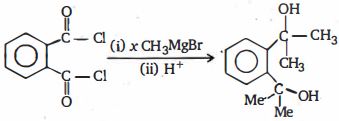
Number of moles of $CH_3MgBr$ consumed in above reaction is
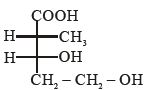
What are the configuration of the two chiral centre?
Given below are two statements : one is labelled as
Assertion A and the other is labelled as Reason $R$ : Assertion A: The first ionisation enthalpy decreases across a period. Reason R: The increasing nuclear charge outweighs the shielding across the period. In the light of the above statements, choose the most appropriate from the options given below:
Most acidic is
In which of the following metallic bond is strongest
Which of these do not undergo Wurtz reaction
The dissolution of $Al(OH)_3$ by a solution of $NaOH$ results in the formation of
For a chemical reaction,$ A + 2B \to C + D,$ the rate of reaction increases three times, when concentration of $A$ only is increased nine times. While when concentration of $B$ only is increased $2\,times,$ then rate of reaction also increases $2\,times$. The order of this reaction is
A decomposes as  the  rate of appearance of $B,$ taking $2\,M$ concentration of $A$ initially, is equal to

$A(g)\,\xrightarrow{{{K_1}\, = \,2\, \times \,{{10}^{ - 3}}\,\,{S^{ - 1}}}}2B\,(g)$

$A(g)\,\xrightarrow{{{K_2}\, = \,1\, \times \,{{10}^{ - 3}}\,\,{S^{ - 1}}}}C\,(g)$

Identify the correct statement for $B _{2} H _{6}$ from those given below.

$(A)$ In $B _{2} H _{6}$, all $B - H$ bonds are equivalent.

$(B)$ In $B _{2} H _{6}$ there are four $3-$centre$-2-$electron bonds.

$(C)$ $B _{2} H _{6}$ is a Lewis acid.

$(D)$ $B _{2} H _{6}$ can be synthesized form both $BF _{3}$ and $NaBH _{4}$.

$(E)$ $B _{2} H _{6}$ is a planar molecule.

Choose the most appropriate answer from the options given below..... .