MCQ
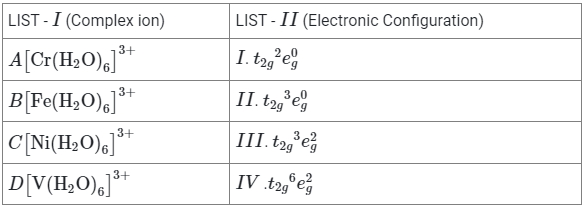
Match List $I$ with List $II$.Choose the correct answer from the options given below :
- A$A-III, B-II, C-IV, D-I$
- B$A-IV, B-I, C-II, D-III$
- C$A-IV, B-III, C-I, D-II$
- ✓$A-II, B-III, C-IV, D-I$
${\left[\mathrm{Fe}\left(\mathrm{H}_2 \mathrm{O}\right)_6\right]^{3+} \text { Contains } \mathrm{Fe}^{3+}:[\mathrm{Ar}] 3 \mathrm{~d}^5: \mathrm{t}_{2 \mathrm{~g}}^3 \mathrm{e}_{\mathrm{g}}^2}$
${\left[\mathrm{Ni}\left(\mathrm{H}_2 \mathrm{O}\right)_6\right]^{2+} \text { Contains } \mathrm{Ni}^{2+}:[\mathrm{Ar}] 3 \mathrm{~d}^8: \mathrm{t}_{2 \mathrm{~g}}^6 \mathrm{e}_{\mathrm{g}}^2}$
${\left[\mathrm{~V}\left(\mathrm{H}_2 \mathrm{O}\right)_6\right]^{3+} \text { Contains } \mathrm{V}^{3+}:[\mathrm{Ar}] 3 \mathrm{~d}^2: \mathrm{t}_{2 \mathrm{~g}}^2 \mathrm{e}_{\mathrm{g}}^{\circ}}$
Generate a complete, print-ready paper with questions like this in minutes — across 16+ boards, with answer keys.
$(a)$ Octahedral $Co(III)$ complexes with strong field ligands have very high magnetic moments
$(b)$ When $\Delta_{0}< P$, the $d-$electron configuration of $Co(III)$ in an octahedral complex is $t_{\text {eg }}^{4} e_{g}^{2}$
$(c)$ Wavelength of light absorbed by $\left[\mathrm{Co}(\mathrm{en})_{3}\right]^{3+}$ is lower than that of $\left[\mathrm{CoF}_{6}\right]^{3-}$
$(d)$ If the $\Delta_{0}$ for an octahedral complex of $\mathrm{Co}(\mathrm{III})$ is $18,000 \;\mathrm{cm}^{-1},$ the $\Delta_{\mathrm{t}}$ for its tetrahedral complex with the same ligand will be $16,000\;\mathrm{cm}^{-1}$
(Rounded off to the nearest integer) [Assume : $\ln 10=2.303, \ln 2=0.693$ ]
Statement I : $\left[\mathrm{Co}\left(\mathrm{NH}_3\right)_6\right]^{3+}$ is a homoleptic complex whereas $\left[\mathrm{Co}\left(\mathrm{NH}_3\right)_4 \mathrm{Cl}_2\right]^{+}$is a heteroleptic complex.
Statement II : Complex $\left[\mathrm{Co}\left(\mathrm{NH}_3\right)_6\right]^{3+}$ has only one kind of ligands but $\left[\mathrm{Co}\left(\mathrm{NH}_3\right)_4 \mathrm{Cl}_2\right]^{+}$has more than one kind of ligands.
In the light of the above statements, choose the correct answer from the options given below.