MCQ
Match the Column $I$ with Column $II$ and select correct answer by given codes.

Column $I$
(Element types)

Column $II$
(Electronic configuration)

$A$. Inert-gas elements $1.\left( {n - 1} \right){d^{1 - 10}}\,n{s^{1 - 2}}$
$B$. Transition elements $2\,. ns^2\,np^6$
$C$. Inner-transition elements $3.\left( {n - 2} \right){f^{1 - 14}}\,\left( {n - 1} \right){s^2}{p^6}{d^{0 - 1}}\,n{s^2}$
  • A
    $A-1;\,B-2,\,C-3$
  • $A-2;\,B-1,\,C-3$
  • C
    $A-3;\,B-2,\,C-1$
  • D
    $A-2;\,B-3,\,C-1$

Answer

Correct option: B.
$A-2;\,B-1,\,C-3$
b

Need a full question paper?

Generate a complete, print-ready paper with questions like this in minutes — across 16+ boards, with answer keys.

Start Generating Free

Similar questions

Which molecule is polar ?
The compound which could not act both as oxidising as well as reducing agent is
The $IUPAC$ name of $\begin{matrix}
   O\,\,\,\,\,\,\,\,\,\,\,\,\,\,\,\,\,\,\,\,\,\,\,\,\,\,\,\,\,\,  \\
   ||\,\,\,\,\,\,\,\,\,\,\,\,\,\,\,\,\,\,\,\,\,\,\,\,\,\,\,\,\,\,  \\
   C{{H}_{3}}-C-CH-CH-C{{H}_{3}}  \\
   \,\,\,\,\,\,|\,\,\,\,\,\,\,\,\,\,\,\,\,|  \\
   \,\,\,\,\,\,\,\,\,\,\,{{C}_{2}}{{H}_{5}}\,\,\,C{{H}_{3}}  \\
\end{matrix}$ is
Given the following $K_a$ values, determine which species is the strongest base,

 $HSO_4^- = 1.2 \times 10^{- 2} ,H_2PO_4^- = 6.3 \times 10^{-8} ,$$HCO_3^- = 4.7 \times 10^{-11}$

Ground state electronic configuration of nitrogen atom can be represented by
The heat of reaction at constant pressure is given by
Which of the following processes does not involve oxidation of iron?
In the reaction of oxalate with permanganate in acidic medium, the number of electrons involved in producing one molecule of $CO_2$ is
Assertion :Fluorine molecule has bond order one.
Reason : The number of electrons in the antibonding molecular orbitals is two less than that in bonding molecular orbitals.
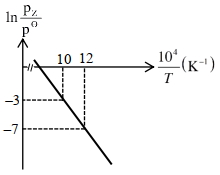
For the reaction $X ( s ) \rightleftharpoons Y ( s )+ Z ( g )$, the plot of $\ln \frac{ p _z}{ p ^\theta}$ versus $\frac{10^4}{T}$ is given below (in solid line), where $p_z$ is the pressure (in bar) of the gas $Z$ at temperature $T$ and $P ^{\ominus}=1$ bar.

(Given, $\frac{ d (\ln K )}{ d \left(\frac{1}{T}\right)}=-\frac{\Delta H^{\ominus}}{ R }$, where the equilibrium constant, $K =\frac{ p _{ z }}{ p ^{\ominus}}$ and the gas constant, $R =8.314$ $\left.J K ^{-1} mol ^{-1}\right)$

($1$) The value of standard enthalpy, $\Delta H ^{\ominus}$ (in $kJ mol ^{-1}$ ) for the reaction is. . . . . . .

($2$) The value of $\Delta S^{\ominus}$ (in $J K ^{-1} mol ^{-1}$ ) for the given reaction, at $1000 K$ is. . . . . . 

Give the answer or quetin ($1$) and ($2$)