Question
 Match the complex species given in Column I with the possible isomerism given in Column II and assign the correct code:

 
Column I (Complex species)
 
Column II (Isomerism)
a.
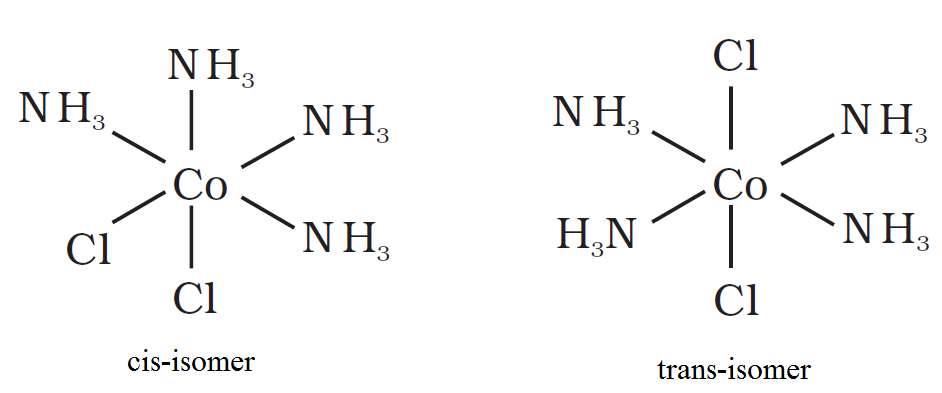
[Co(NH3)4Cl2]+
1.
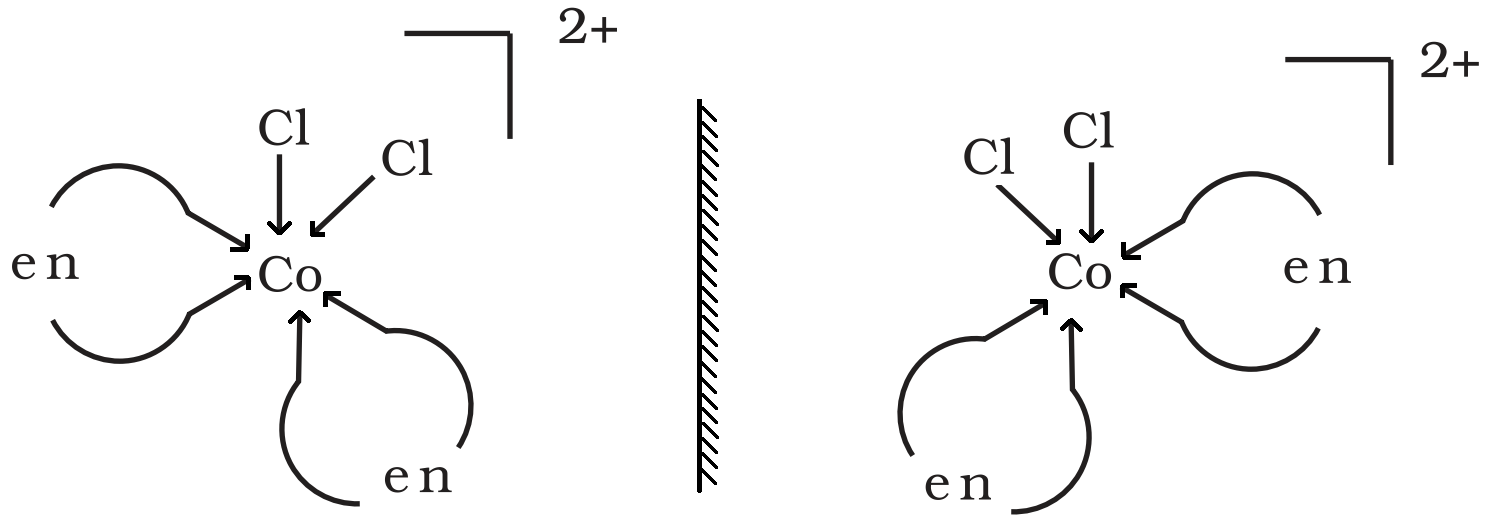
Optical
b.
cis-[Co(en)2Cl2]+
2.
Ionisation
c.
[Co(NH3)5 (NO2)]Cl2
3.
Coordination
d.
[Co(NH3)6][Cr(CN)6]
4.
Geometrical
 
 
5.
Linkage

Code:

  1. A (1), B (2), C (4), D (5).
  2. A (4), B (3), C (2), D (1).
  3. A (4), B (1), C (5), D (3).
  4. A (4), B (1), C (2), D (3).

Need a full question paper?

Generate a complete, print-ready paper with questions like this in minutes — across 16+ boards, with answer keys.

Start Generating Free

Similar questions

(i). Write the structures of main products when benzene diazonium chloride $\left( C _6 H _5 N_2^{+} Cl ^{-}\right)$ reacts with the following reagents.
a. $HBF _4 / \Delta$
b. $Cu / HBr$
(ii). Write the structures of A, B and C in the following reactions:
a. $C _6 H _5 NO _2 \xrightarrow{ Sn / HCl } A \xrightarrow[\Delta]{ NaNO _2+ HCl } B \xrightarrow{273 K} H$
b. $CH _3 Cl \xrightarrow{ KCN } A \xrightarrow{ LiAlH _4} B \xrightarrow[273 K]{\stackrel{273 K}{ HNO }{ }_2} C$
(a) Why $\alpha$-hydrogen of carbonyl compound are acidic in nature?
(b) Explain aldol condensation reaction of ethanal.
The activation energy of a reaction is 75.2kJ mol-1 in the absence of a catalyst and it lowers to 50.14kJ mol-1with a catalyst. How many times will the rate of reaction grow in the presence of a catalyst if the reaction proceeds at 25°C?
[A], [B], [C], [D], [E], [F] and [G] are amines each of which forms a hydrochloride containing 32.42% chlorine. [A], [B], [C] and [D] evolve N2 on reaction with HNO2, but [E], [F], [G] and [H] do not. Give structures of [A] to [H] with reasons.
(i) Define the order of a reaction.
(ii) Explain the effect of concentration of reactant on the rate constant.
(iii) For a first order reaction, if the rate constant at 500 K and 600 K are $0.03 s^{-1}$ and $0.06 s^{-1}$ respectively, then calculate the activation energy.
$
\left[R=8.314 JK^{-1} mol^{-1}, \log 2=0.3010\right]
$
(i) Define molecularity of a reaction.
(ii) Explain the effect of presence of catalyst on the rate of reaction.
(iii) In a first order reaction at 300 K , the initial concentration of the reactant was $1.0 \times 10^{-2} mol L ^{-1}$, which decreased to $0.5 \times 10^{-2} molL ^{-1}$ after 30 minutes at 300 K . Calculate the rate constant of the reactant at 300 K. $[\log 2=0.3010] \quad$
  1. Answer the following questions briefly:
  1. What are reducing sugars?
  2. What is meant by denaturation of a protein?
  3. How is oxygen replenished in our atmosphere?
  1. Define enzymes.
Explain the structure and classification of animes.
  1. Account for the following:
  1. Transition metals form large number of complex compounds.
  2. The lowest oxide of transition metal is basic whereas the highest oxide is amphoteric or acidic.
  3. E° value for the Mn3+/Mn2+ couple is highly positive (+1.57 V) as compare to Cr3+/Cr2+. 56/1/1 9.
  1. Write one similarity and one difference between the chemistry of lanthanoid and actinoid elements.
Match the terms given in Column I with the units given in Column II.

 
Column I


Column II

i.

$\wedge_{\text{m}}$

a.

Intensive property.

ii.

$\text{E}^{\ominus}_{\text{Cell}}$

b.

Depends on number of ions/volume.

iii.

$\text{K}$

c.

Extensive property.

iv.

$\Delta_{\text{r}}\text{G}_{\text{Cell}}$

d.

Increases with dilution.