Question
Match the following items given in Column $A$ with that in Column $B$:
S.No.
Column $A$
S.No.
Column $B$
$(a)$
Cell
$(i)$
Allows electricity to pass through it.
$(b)$
Battery
$(ii)$
Either breaks or completes a circuit.
$(c)$
Conductor
$(iii)$
Converts electricity into light.
$(d)$
Insulator
$(iv)$
Glows when electricity passes in it.
$(e)$
Switch
$(v)$
A device which produces electricity.
$(f)$
Bulb
$(vi)$
Is a path of electricity.
$(g)$
Filament
$(vii)$
Does not allow electricity to pass.
$(h)$
Circuit
$(viii)$
A combination of cells.

Answer

S.No.
Column $A$
S.No.
Column $B$
$(a)$
Cell
$(v)$
A device which produces electricity.
$(b)$
Battery
$(viii)$
A combination of cells.
$(c)$
Conductor
$(i)$
Allows electricity to pass through it.
$(d)$
Insulator
$(vii)$
Does not allow electricity to pass.
$(e)$
Switch
$(ii)$
In Either breaks or completes a circuit.
$(f)$
Bulb
$(iii)$
Converts electricity into light.
$(g)$
Filament
$(iv)$
Glows when electricity passes in it.
$(h)$
Circuit
$(vi)$
Is a path of electricity.

Need a full question paper?

Generate a complete, print-ready paper with questions like this in minutes — across 16+ boards, with answer keys.

Start Generating Free

Similar questions

Rahul and Sonia were playing with blocks and each of them made a train out of them. Both of them thought of measuring the length of the train using their handspan. By that time Rahul's friend Anupam came and suggested them to measure with a measuring tape for fair result.
$(a)$ What is a handspan?
$(b)$ Why Anupam asked both of them to use measuring tape?
$(c)$ What value of Anupam is shown here?
Write short notes on the following.
  1. Skull.
  2. Chest bones.
  3. Backbone.
  4. Hip bone.
  5. The shoulder bone.
  6. Limb bone.
The process of condensation plays an important role in bringing water back to the surface of earth. Explain how?
Directions: Read the passage $(s)$ given below and answer the questions that follow. Passage - $1$ Look at the following food chain and then answer the questions that follow. Grain $\rightarrow $ grasshopper $\rightarrow $ frogs $\rightarrow $ snakes $\rightarrow $ owls bacteria Which organism in this food chain is responsible for recycling nutrients?
  1. Snakes.
  2. Bacteria.
  3. Owls.
  4. Grasshopper.
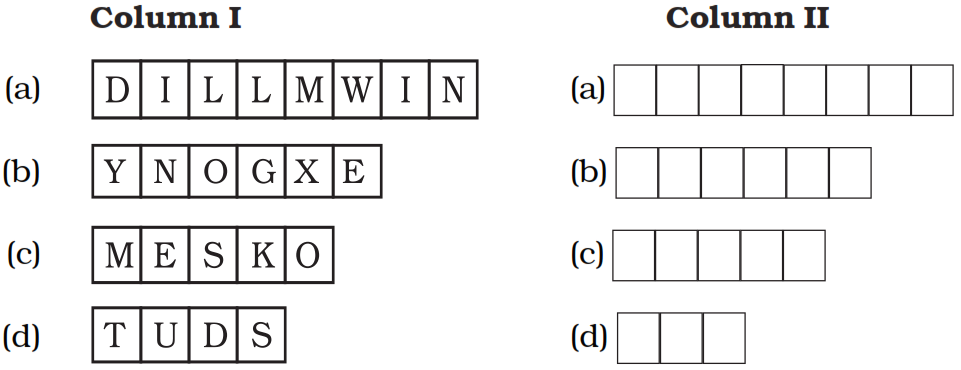
In the boxes of Column $I$ the letters of some words got jumbled. Arrange them in proper form in the boxes given in Column $II$
List all items known to you that float on water. Check and see if they will float on an oil or kerosene.
Select leaves showing reticulate venation and those showing parallel venation from the list given below and write them in the tabular form:
Peepal, neem, grass, mustard, methi, dhania (coriander), rose, tulsi, mango, sugarcane, maize, mint, wheat, rice.
Match the items in Column $I$ with one or more items of Column $II$.
S.No
Column $I$
 
Column $II$
$(i)$
Upper jaw
$(i)$
Have fins on the body.
$(ii)$
Fishes
$(ii)$
Has an outer skeleton.
$(iii)$
Ribs
$(iii)$
Can fly in the air.
$(iv)$
Snail
$(iv)$
Is an immovable joint.
$(v)$
Cockroach
$(v)$
Protect the heart.
 
-
$(vi)$
Shows very slow movement.
 
-
$(vii)$
Have a streamlined body.
Beautiful hand crafted articles like boxes and toys are made of paper pulp in our country. Can you explain how paper pulp which is made from paper can be used to make hard boxes and other articles?
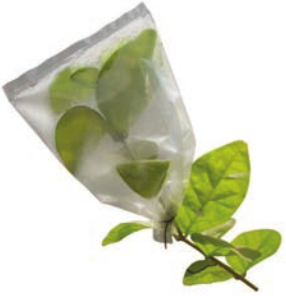
Observe the picture of an activity given as Fig carried out with leaves of plants and polythene bag.

Now answer the following:
  1. Which process is demonstrated in the activity?
  2. When will this activity show better results–on a bright sunny day or a cloudy day?
  3. What will you observe in the polythene bag after a few hours of setting up the activity?
  4. Mention any one precaution you must take while performing this activity.