Question
Match the following statements:
  Column $A$   Column $B$
$i$ Line segment has $a$ at a point
$ii$ Two segments may intersect $b$ if they have equal lengths
$iii$ Two segments are congruent $c$ two end-point
$iv$ Line segment is $d$ portion of a line

Answer

  Column $A$   Column $B$
$i$ Line segment has $c$ two end$-$point
$ii$ Two segments may intersect $a$ at a point
$iii$ Two segments are congruent $b$ if they have equal lengths
$iv$ Line segment is $d$ portion of a line
Solution:
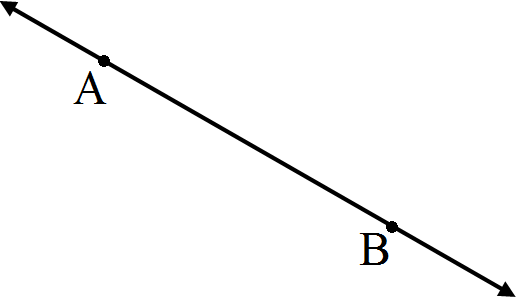
$i.\ $A line segment is a part of a line that is bounded by two distinct end points.

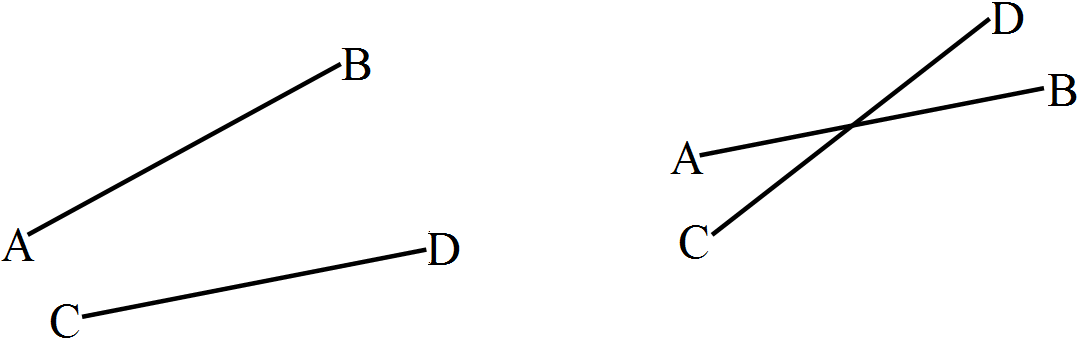
$ii.\ $Two line segments will either not intersect at all or intersect at one point. It can never intersect at more than one point.

$iii.\ $Line segments are congruent if they have the same lengths. If $AB = 6\ cm$ and $CD = 6\ cm$ Then, $AB$ and $CD$ are congruent.
$iv.\ $A line segment is a part of a line that is bounded by two distinct end points.

Need a full question paper?

Generate a complete, print-ready paper with questions like this in minutes — across 16+ boards, with answer keys.

Start Generating Free

Similar questions

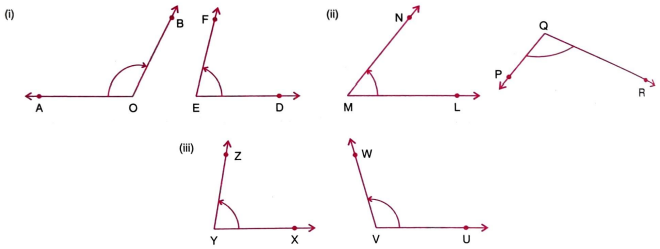
By simply looking at the pair of angles given in Fig., state which of the angles in each of the pairs is greater:
Image
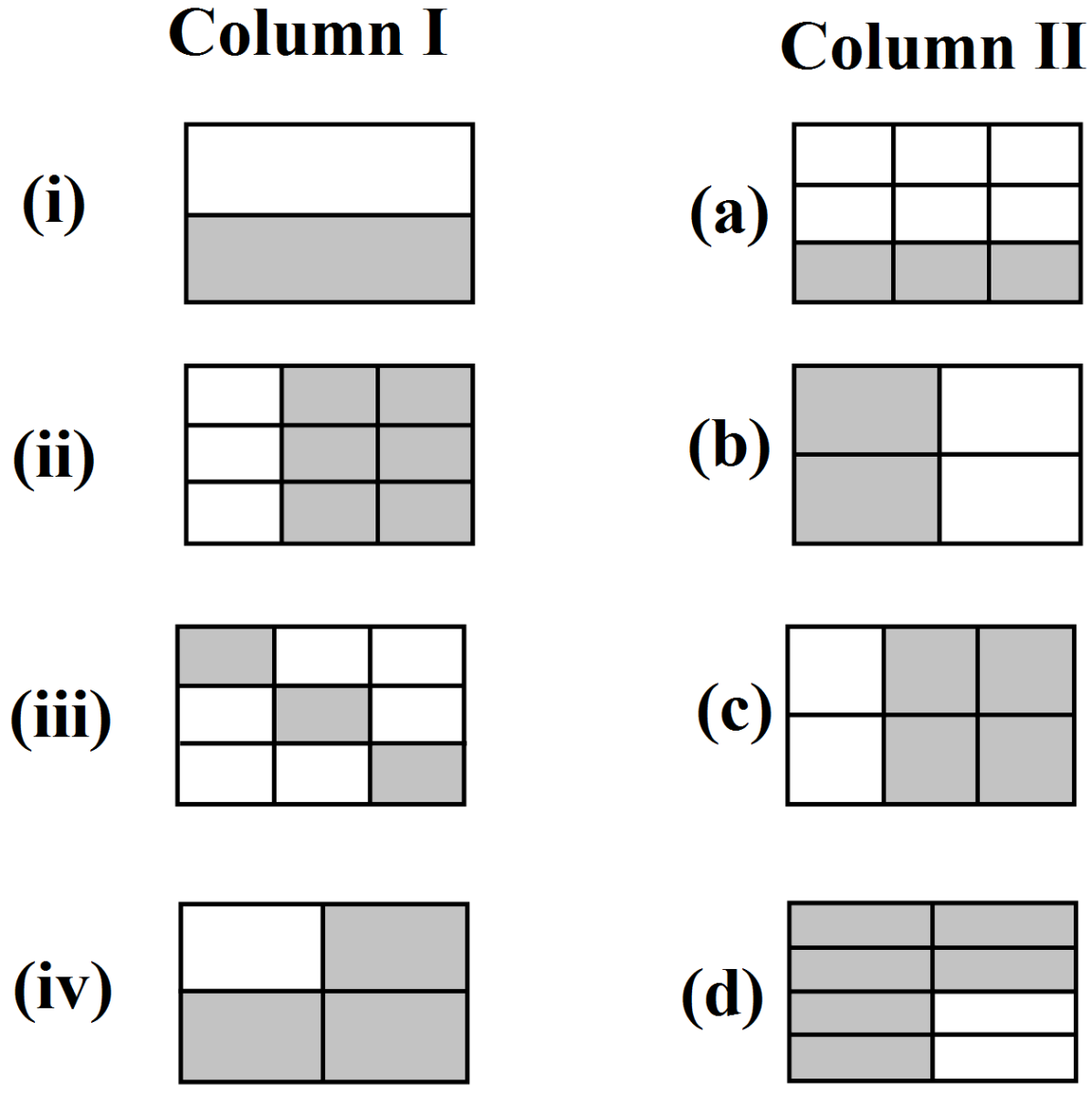
Write the fractions and match fractions in Column $ I$ with the aquivalent fractions in Column $II.$
Draw a line $AB$ and take two points $C$ and $E$ on opposite sides of $AB.$ Through $C,$ draw $\text{CD}\perp\text{AB}$ and through $E$ draw $\text{EF}\perp\text{AB}.$ Using ruler and compassed.
Can we have two acute angles whose sum is:
$a.\ $An acute angle? Why or why not?
$b.\ $A right angle? Why or why not?
$c.\ $An obtuse angle? Why or why not?
$d.\ $A straight angle? Why or why not?
$e.\ $A reflex angle? Why or why not?
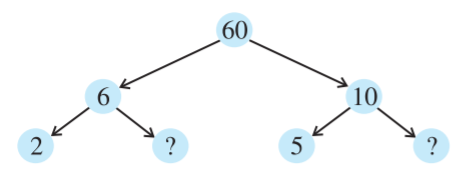
Here are two different factor trees for $60$. Write the missing numbers.
Draw a line segment of length $10\ cm$ and bisect it. Further bisect one of the equal parts and measure its length.
Draw $\angle\text{ABC}$ os measure $60^\circ $ such that $AB = 4.5\ cm$ and $BC = 5\ cm$ and $BC = 5\ cm.$ Through C draw a line parallel to $AB$ and through $B$ draw a line parallel to $AC.$ Intersecting each other at $D.$ Measure $BD$ and $CD.$
Draw a line $AB.$ Take a point $P$ outside it. Draw a line passing through $P$ and parallel to $AB.$
Draw a rectangle whose two adjacent sides are $5\ cm$ and $3.5\ cm$. Make use of a pair of compasses and a ruler only.
Alok purchased $1\ kg\ 200\ g$ potatoes, $250\ g$ dhania, $5\ kg\ 300\ g$ onion, $500\ g$ palak and $2\ kg\ 600\ g$ tomatoes. Find the total weight of his purchases in kilograms.