Question
Match the following statements:
  Column A   Column B
i Line segment has a at a point
ii Two segments may intersect b if they have equal lengths
iii Two segments are congruent c two end-point
iv Line segment is d portion of a line

Answer

  Column A   Column B
i Line segment has c two end-point
ii Two segments may intersect a at a point
iii Two segments are congruent b if they have equal lengths
iv Line segment is d portion of a line
Solution:
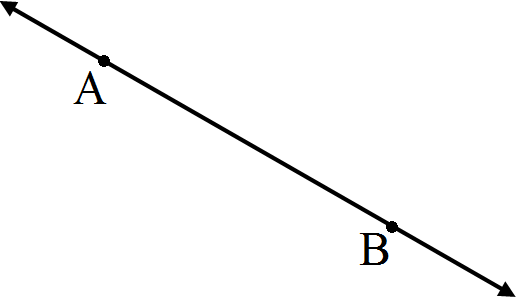
  1. A line segment is a part of a line that is bounded by two distinct end points.
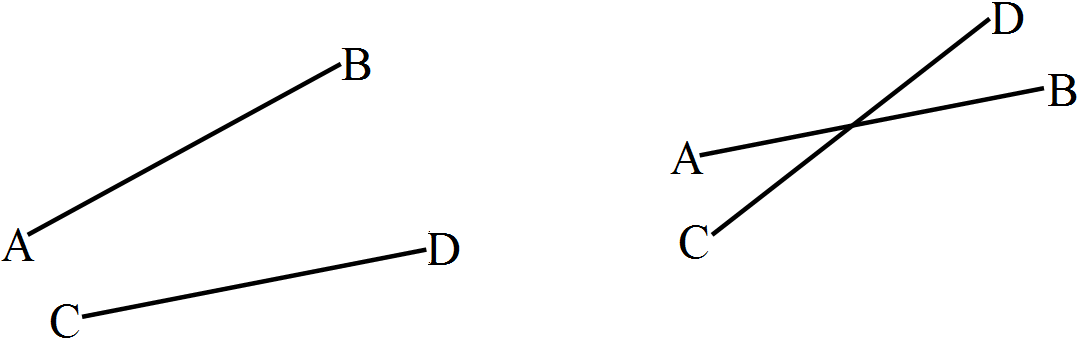
  1. Two line segments will either not intersect at all or intersect at one point. It can never intersect at more than one point.
  1. Line segments are congruent if they have the same lengths. If AB = 6cm and CD = 6cm Then, AB and CD are congruent.
  2. A line segment is a part of a line that is bounded by two distinct end points.

Need a full question paper?

Generate a complete, print-ready paper with questions like this in minutes — across 16+ boards, with answer keys.

Start Generating Free

Similar questions

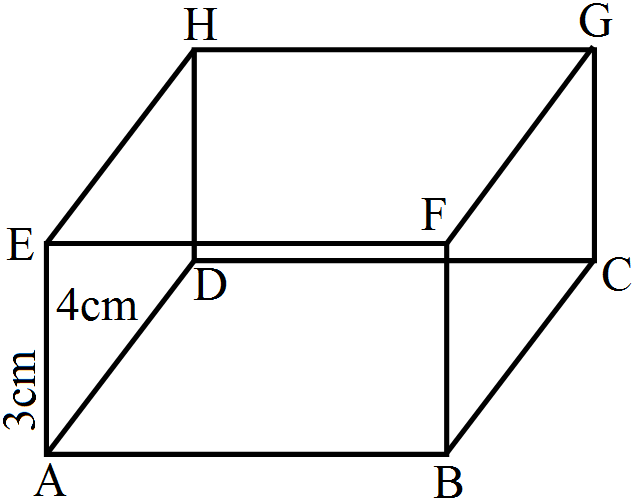
The dimensions of a cuboid with vertices A, B, C, D, E, F, G and H are as shown:


i. Which edges are of length 4 cm ? Which edges are of length 5 cm ?
ii. Which faces have area equal to $20 cm^2$ ?
iii. Which faces have the largest area? What is this largest area?
iv. Which faces have a diagonal equal to 5 cm ?
v . What is the area of the base of this cuboid?
vi. Do all the lateral faces have the same area?
Define (i) FACTOR, (ii) MULTIPLE. Give five example of each.
Find the HCF of the numbers in the following using the division method:391, 425, 527
Ramanujan’s Magic square.

22121887
8817925
10248916
19862311
  • Add the four numbers in the rows, the columns and along the diagonals of this square.
  • What is the sum?
  • Is it the same every time?
  • What is the peculiarity?
  • Look at the numbers in the first row, 22 – 12 – 1887. Find out why this date is special.

Obtain and read a biography of the great Indian mathematician Srinivasa Ramanujan.

Measure of the angle Type of the angle
i. 180° a. Zero angle
ii. 240° b. Straight angle
iii. 360° c. Reflex angle
iv. d. Complete angle
The following table shows the daily production of T.V. sets in an industry for 7 days of a week:
Day
Mon
Tue
Wed
Thurs
Fri
Sat
Sun
Number of T.V. Sets
300
400
150
250
100
350
200
Represent the above information by a pictograph.
Draw a reactangle whose two adjacent sides are 5.4cm and 3.5cm.
Draw a line AB and take two points C and E on opposite sides of AB. Through C, draw $\text{CD}\perp\text{AB}$ and through E draw $\text{EF}\perp\text{AB}.$ Using ruler and compassed.
$7 \frac{1}{2}-3 \frac{1}{5}$
Draw a pair of vertically opposite angles. Bisect each of the two angles. Verify that the bisecting rays are in the same line.