Question
Match the items given in Column I with the type of solutions given in Column II.
 
Column I
 
Column II
i.
Soda water
a.
A solution of gas in solid.
ii.
Sugar solution
b.
A solution of gas in gas.
iii.
German silver
c.
A solution of solid in liquid.
iv.
Air
d.
A solution of solid in solid.
v.
Hydrogen gas in palladium
e.
A solution of gas in liquid.
 
 
f.
A solution of liquid in solid.

Answer

 
Column I
 
Column II
i.
Soda water
e.
A solution of gas in liquid.
ii.
Sugar solution
c.
A solution of solid in liquid.
iii.
German silver
d.
A solution of solid in solid.
iv.
Air
b.
A solution of gas in gas.
v.
Hydrogen gas in palladium
a.
A solution of gas in solid.
 
 
f.
A solution of liquid in solid.

Need a full question paper?

Generate a complete, print-ready paper with questions like this in minutes — across 16+ boards, with answer keys.

Start Generating Free

Similar questions

Which of the following compounds would undergo aldol condensation, which the Cannizzaro reaction and which neither? Write the structures of the expected products of aldol condensation and Cannizzaro reaction.
  1. Methanal
  2. 2-Methylpentanal
  3. Benzaldehyde
  4. Benzophenone
  5. Cyclohexanone
  6. 1-Phenylpropanone
  7. Phenylacetaldehyde
  8. Butan-1-ol
  9. 2,2-Dimethylbutanal.
Write the formulas for the following coordination compounds:
a. Tetraammineaquachloridocobalt(III) chloride
b. Potassium tetrahydroxidozincate(II)
c. Potassium trioxalatoaluminate(III)
d. Dichloridobis(ethane-1, 2-diamine)cobalt(III)
e. Tetracarbonylnickel(0)
Rate constant for a first order reaction has been found to be $2.54 \times 10^{-3} \mathrm{~s}^{-1}$. Calculate its three-fourth life.
Explain the relationship between $\Delta G$ and $E _{\text {cell }}^{\circ}$ with the help of an example.

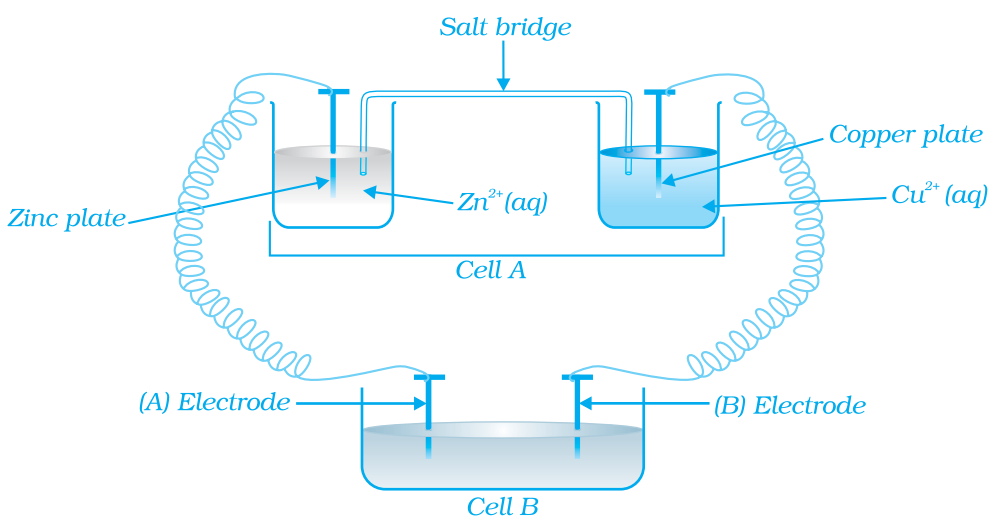
Consider the and answer the following questions.

i. Cell 'A' has $E_{\text {Cell }}=2 \mathrm{~V}$ and Cell 'B' has $E_{\text {Cell }}=1.1 \mathrm{~V}$ which of the two cells ' $A$ ' or ' $B$ ' will act as an electrolytic cell. Which electrode reactions will occur in this cell?
ii. If cell 'A' has $E_{C e l l}=0.5 \mathrm{~V}$ and cell 'B' has $E_{C e l l}=1.1 \mathrm{~V}$ then what will be the reactions at anode and cathode?
State the reactions and reaction conditions for the following conversions:
i. Benzene diazonium chloride to nitrobenzene.
ii. Aniline to benzene diazonium chloride.
iii. Ethylamine to methylamine.
Match the properties given in Column I with the metals given in Column II.
 
Column I (Property)
 
Column II (Metal)
$(i)$
Element with highest second ionisation enthalpy
$(a)$
$Co$
$(ii)$
Element with highest third ionisation enthalpy
$(b)$
$Cr$
$(iii)$
$M$ in $M$ $(CO)6$ is
$(c)$
$Cu$
$(iv)$
Element with highest heat of atomisation
$(d)$
$Zn$
   
$(e)$
$Ni$
Mr. Roy, the principal of one reputed school organised a seminar in which he invited parents and principals to discuss the serious issue of diabetes and depression in students.They all resolved this issue by strictly banning the junk food in schools and to introduce healthy snacks and drinks like soup, lassi, milk etc. in school canteens. They also decided to make compulsory half an hour physical activities for the students in the morning assembly daily. After six months, Mr. Roy conducted the health survey in most of the schools and discovered a tremendous improvement in the health of students.

After reading the above passage, answer the following:
  1. What are the values (at least two) displayed by Mr. Roy?
  2. As a student, how can you spread awareness about this issue?
  3. What are tranquillizers? Give an example.
  4. Why is use of aspartame limited to cold foods and drinks?
$CoSO_4Cl._5NH_3$ exists in two isomeric forms $'A \ '$ and $'B \ '.$ Isomer $'A \ '$ reacts with $AgNO_3$ to give white precipitate but does not react with $BaCl_2.$ Isomer $ 'B \ '$ gives a white precipitate with $BaCl_2$ but does not react with $AgNO_3.$ Answer the following questions.
$i.$ Identify $'A \ '$ and $'B\ '$ and write their structural formulas.
$ii.$ Name the type of isomerism involved.
$iii.$ Give the $ \text{IUPAC}$ name of $'A\ '$ and $'B \ '.$
What is crystal field theory? On the basis of this, explain the crystal field splitting in octahedral coordinaton compounds.