Question

Match the reactions given in Column I with the names given in Column II.
  Column I   Column II
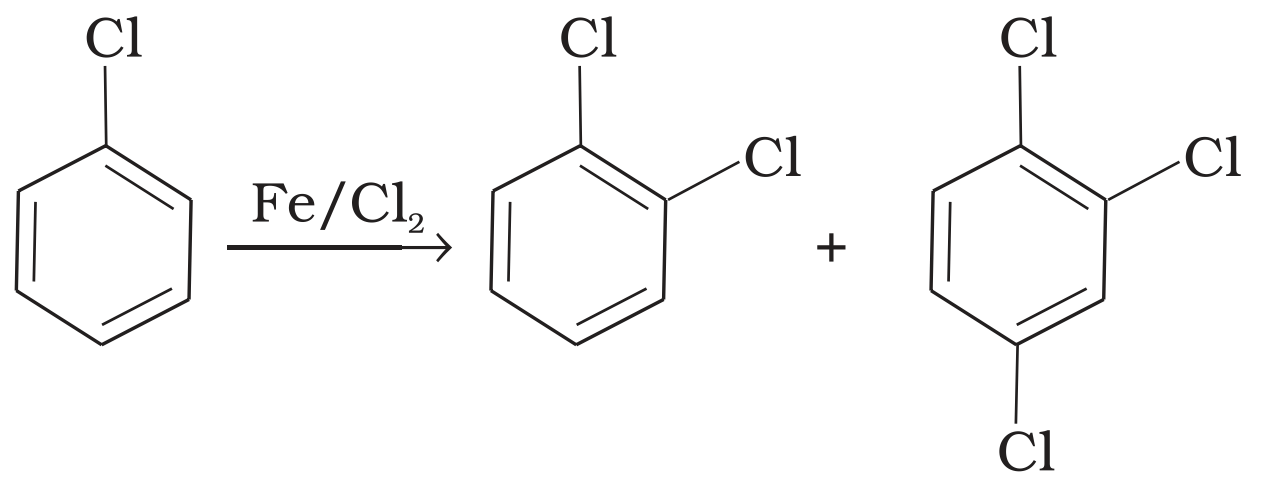
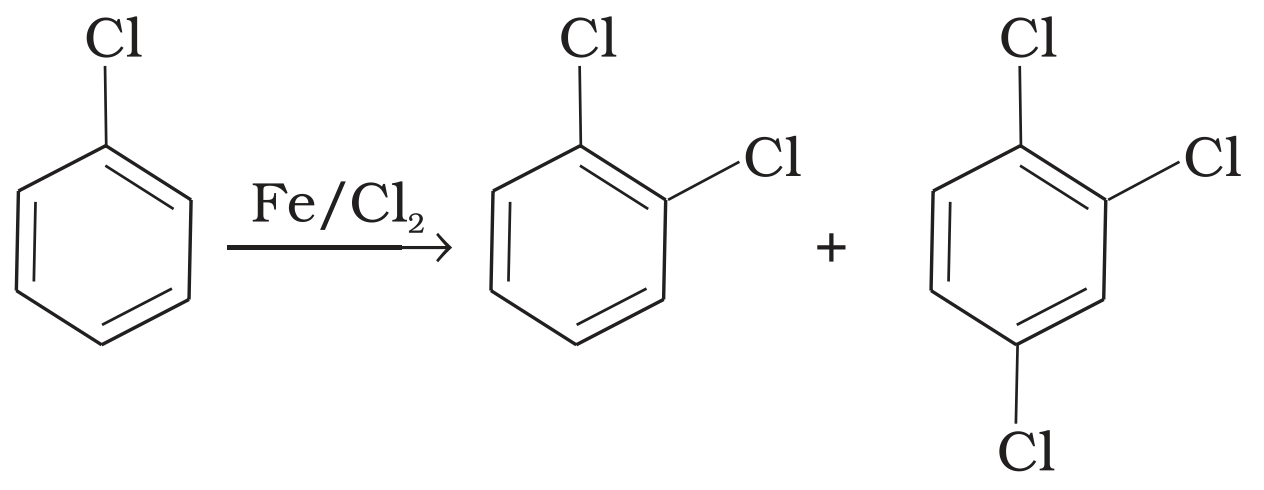
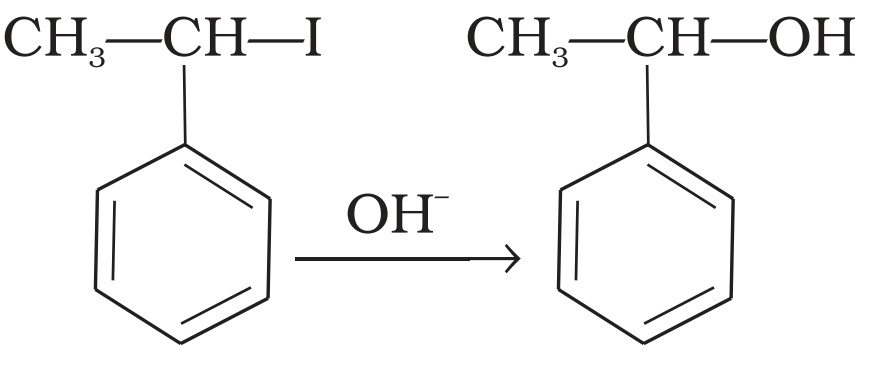
(i) (a) Nucleophilic aromatic substitution
(ii) $\text{CH}_3-\text{CH}==\text{CH}_2+\text{HBr}\xrightarrow{ \ \ \ \ \ }\text{CH}_3-\text{CH}-\text{CH}_3\ \ \ \ \ \ \ \ \ \ \ \ \ \ \ \ \ \ \ \ \ \ \ \ \ \ \ \ \ \ \ \ \ \ \ \ | \ \ \ \ \ \ \ \ \ \ \ \text{Br}$ (b) Electrophilic aromatic substitution
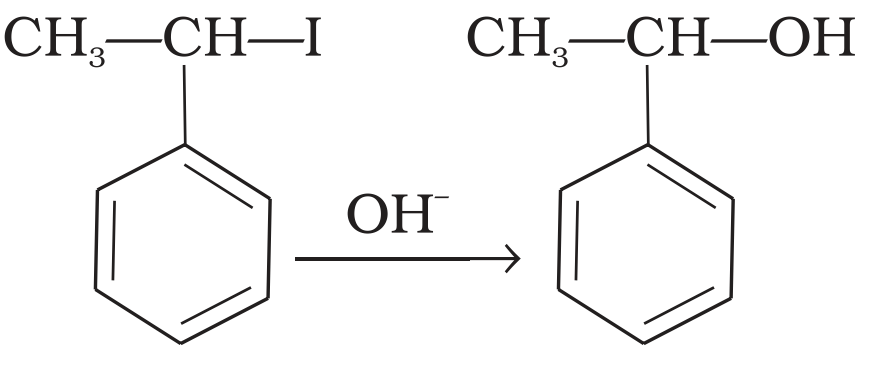
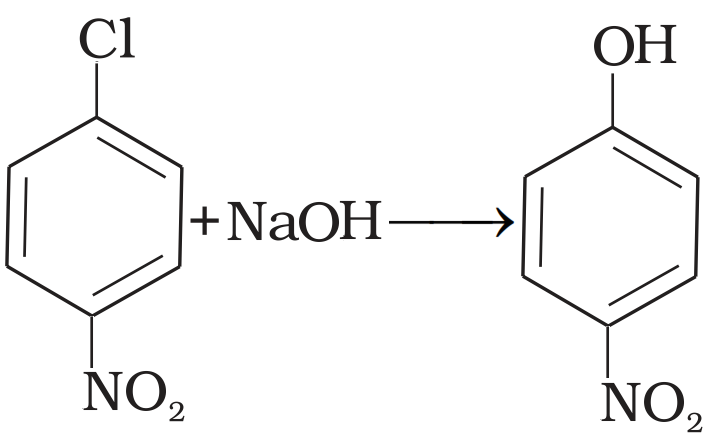
(iii) (c) Saytzeff elimination
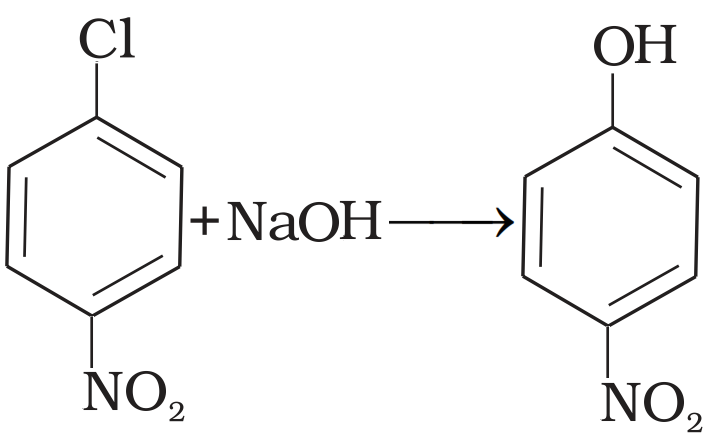
(iv) (d) Electrophilic addition
(v) $\text{CH}_3\text{CH}_2\text{CH}\text{CH}_3\xrightarrow{\text{alc.KOH}}\text{CH}_3\text{CH}==\text{CH}\text{CH}_3\ \ \ \ \ \ \ |\ \ \ \ \ \ \ \ \ \ \ \ \ \ \ \ \text{Br}$ (e) Nucleophilic substitution $(S_N1)$

Answer

  Column I   Column II
(i) (b) Electrophilic aromatic substitution
(ii) $\text{CH}_3-\text{CH}==\text{CH}_2+\text{HBr}\xrightarrow{ \ \ \ \ \ }\text{CH}_3-\text{CH}-\text{CH}_3\\ \ \ \ \ \ \ \ \ \ \ \ \ \ \ \ \ \ \ \ \ \ \ \ \ \ \ \ \ \ \ \ \ \ \ \ \ \ \ \ \ \ \ \ \ \ \ \ \ \ \ \ \ \ \ \ \ \ \ \ \ \ \ \ \ \ \ \ | \ \ \ \ \ \\ \ \ \ \ \ \ \ \ \ \ \ \ \ \ \ \ \ \ \ \ \ \ \ \ \ \ \ \ \ \ \ \ \ \ \ \ \ \ \ \ \ \ \ \ \ \ \ \ \ \ \ \ \ \ \ \ \ \ \ \ \ \ \ \ \ \ \ \text{Br}$ (d) Electrophilic addition
(iii) (e) Saytzeff elimination
(iv) (a) Nucleophilic substitution $(S_N1)$
(v) $\text{CH}_3\text{CH}_2\text{CH}\text{CH}_3\xrightarrow{\text{alc.KOH}}\text{CH}_3\text{CH}==\text{CH}\text{CH}_3\\ \ \ \ \ \ \ \ \ \ \ \ \ \ \ \ \ |\\ \ \ \ \ \ \ \ \ \ \ \ \ \ \ \ \text{Br}$ (c) Saytzeff elimination
Explanation:
  1. In this reaction, an electrophile $CF$ attacks on to the benzene ring and substitution takes place.
  2. In this reaction, addition of HBr takes place on to the doubly bonded carbons of propene in accordance with Markownikoff’s rule and electrophilic addition takes place.
  3. In this reaction, the reactant is secondary halide. Here, halogen atom is substituted by hydroxyl ion. As it is secondary halide so it follows ${S_N}^1$ mechanism.
  4. In this reaction, halogen atom is directly bonded to aromatic ring. So, it is nucleophilic aromatic substitution as $OH^–$ group has substituted halogen of given compound.
  5. It is an elimination reaction. It follows Saytzeff elimination rule.

Need a full question paper?

Generate a complete, print-ready paper with questions like this in minutes — across 16+ boards, with answer keys.

Start Generating Free