Question
Match the statements in column $A$ with that in column $B$
Column $A$ Column $B$
$(a)$ deliquescent substance $(1)$ sodium bicarbonate
$(b)$ hygroscopic substance $(2)$ magnesium chloride
$(c)$ efflorestance substance $(3)$ conc. sulphuric acid
$(d)$ substance causing temporary hardness $(4)$ washing soda

Answer

Column $A$ Column $B$
$(a)$ deliquescent substance $(2)$ magnesium chloride
$(b)$ hygroscopic substance $(3)$ conc. sulphuric acid
$(c)$ efflorestance substance $(4)$ washing soda
$(d)$ substance causing temporary hardness $(1)$ sodium bicarbonate

Need a full question paper?

Generate a complete, print-ready paper with questions like this in minutes — across 16+ boards, with answer keys.

Start Generating Free

Similar questions

State the main postulates of $-$ Dalton’s atomic theory. Explain how the modern atomic theory contradicted Dalton’s atomic theory.
State the law of conservation of mass.
What are $(i)$ positive catalysts and $(ii)$ negative catalysts? Support your answer with one example for each of them.
Explain in brief $–$ Goldstein’s experiment which led to the discovery of the proton and $–$ Lod Rutherford’s experiment which led to the discovery of the atomic nucleus.
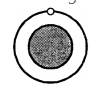
The diagram represents an isotope of hydrogen $[H],$ Answer the following:
Image
At. no.$ = 1$
Mass no. $= 1$
$1.$ Are isotopes atoms of the same element or different elements.
$2.$ Do isotopes have the same atomic number or the same mass number.
$3.$ If an isotope of $‘H’$ has mass no.$ = 2$, how many electrons does it have.
$4.$ If an isotope of ‘$H’$ has mass no. $= 3$, how many neutrons does it have.
$5.$ Which sub$-$atomic particles in the $3$ isotopes of $‘H’ $ are the same.
Name three fundamental particles of the atom. Give the symbol with charge, on each particle.
Valency is also the number of electrons $-$ donated or accepted by an atom so as to achieve stable electronic configuration of the nearest noble gas'. With reference to this definition $-$
$a.$ State what is meant by 'stable electronic configuration'.
$b.$ State why the valency of $-$
$i.$ sodium, magnesium $\& $ aluminium is : $+1,+2 \&+3$ respectively.
$ii.$ chlorine, oxygen $\&$ nitrogen is : $-1,-2 \&-3$ respectively.
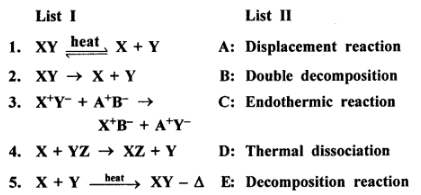
Match the chemical reactions in List $I$ with the appropriate answer in List $II$.
Image
State the valencies of the following metallic elements $–$
$(a)$ Potassium
$(b)$ Sodium
$(c)$ Calcium
$(d)$ Magnesium
$(e)$ Zinc
$(f)$ Aluminium
$(g)$ Chromium
write each symbol with the valency
Match the colunm
column $A$ column $B$
$1.$ A product of incomplete burning $a.$ Hopcolite
$2.$ Nature of carben monoxide $b.$ Combustible gas
$3.$ A compound formed by the combination of haemoglobin and carbon monoxide $c.$ carboxy$-$haemoglobin
$4.$ A mixture of metallic oxides $d.$ Carbon monoxide
$5.$ Carbon monoxide $e.$ Highly poisonous