Question
Match the statements in Column $A$ with those in Column $B.$
Column $A$ Column $B$
$1.$ A metal which reacts with cold water to from hydrogen. $1.$ Reduction
$2.$ A gas which is inflammable and non$-$supporter of combustion $2.$ Hydrogenation
$3.$ A process in which vanspati ghee is prepared from vegitable oils $3.$ oxidation
$4.$ The removal ofhydrogen or addition of oxygen $4.$ sodium
$5.$ The addition of hydrogen or removal of oxygen $5.$ Hydrogen

Answer

Column $A$ Column $B$
$1.$ A metal which reacts with cold water to from hydrogen. $4.$ sodium
$2.$ A gas which is inflammable and non$-$supporter of combustion $5.$ Hydrogen
$3.$ A process in which vanspati ghee is prepared from vegitable oils $2.$ Hydragenation
$4.$ The removal hydrogen or addition of oxygen. $3.$ oxidation
$5.$ The addition hydrogen or removal of oxygen $1.$ Reduction

Need a full question paper?

Generate a complete, print-ready paper with questions like this in minutes — across 16+ boards, with answer keys.

Start Generating Free

Similar questions

Draw the atomic diagrams of the following elements showing the distribution of $-$ protons, neutrons  the electrons in the various shells of the atoms.
$a$. Carbon $-{ }^{12} C$
$b$. Oxygen $-{ }_8^{16} O$
$c$. Phosphorus $-{ }^{31}{ }_{15} P$
$d$. Argon $-{ }^{40}{ }_{18} Ar$
$e$. Calcium $-{ }_{20}^{40} Ca$
$[$The upper number represents the $-$ mass number $\ $ the lower number the $ -$ atomic number e.g. calcium $-$ mass number $=40$, atomic number $=20]$
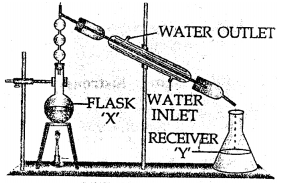
The diagram represents fractional distillation for separation mixtures. Answer the following
Image
$1.$ Can two immiscible liquids be separated by this process.
$2.$ Separation of liquids by this process is based on which physical property?
$3.$ If methyl alcohol $\&$ water are to be separated, which liquid would remain in flask ‘$X$’ after condensation.
$4.$ Give a reason for the above answer.
$5.$ State the purpose of the fractionating column in the apparatus.
With reference to inter-conversion of matter $–$ on the basis of kinetic theory $–$ explain in brief the conversion of:
$(a)$ A solid into a liquid
$(b)$ A liquid into vapour $[$or gas$]$
$(c)$ Vapour [or gas] into a liquid
$(d)$ A liquid into a solid
With special reference to inter$-$particle space $\&$ interparticle attraction at the different stages of conversion.
State the law of conservation of mass.
Write balanced molecular equations for the following word equations:
$(a)$ Calcium $+$ oxygen $\rightarrow$ Calcium oxide
$(b)$ Calcium $+$ water $\rightarrow$ Calcium $+$ hydrogen
$(c)$ Zinc $+$ sulphuric hydroxide $\rightarrow$ Zinc sulphate $+$ hydrogen
$(d)$ Lead sulphate acid $+$ ammonium hydroxide $\rightarrow$ Ammonium sulphate $+$ lead hydroxide
$(e)$ Copper hydroxide $+$ nitric acid $\rightarrow$ Copper nitrate $+$ water
$(f)$ Lead nitrate $+$ sodium Chloride $\rightarrow$ Sodium nitrate $+$ lead Chloride
Explain in brief $–$ Goldstein’s experiment which led to the discovery of the proton and $–$ Lod Rutherford’s experiment which led to the discovery of the atomic nucleus.
State the main postulates of kinetic theory of matter.
Select the chemical changes from the following list of changes $–$
$(a)$ Vaporisation of water into water vapour.
$(b)$ Boiling of milk.
$(c)$ Respiration in mammals.
$(d)$ Rotting of eggs.
$(e)$ Drying of a fruit.
$(f)$ The carbon cycle.
$(g)$ Occurrence of lightening.
$(h)$ Breaking of glass.
$(i)$ Butter turning rancid.
$(j)$ Glowing of an electric bulb.
$(k)$ Crystallisation of a salt from its solution.
$(l)$ Change of seasons.
$(m)$ Preparation of carbon dioxide from calcium carbonate & dilute hydrochloric acid.
State any one method $–$ to separate the following mixtures$-$
$(a)$ Two solid mixtures one of which $–$ directly changes into vapour on heating.
$(b)$ Two solid mixtures one of which $–$ dissolves in a particular solvent and other does not
$(c)$ A solid-liquid mixture containing $–$ an insoluble solid in the liquid component
$(d)$ A solid-liquid mixture containing $–$ a soluble solid in the liquid component
$(e)$ A liquid-liquid mixture containing $–$ two immiscible liquids having different densities
$(f)$ A liquid-liquid mixture containing $–$ two miscible liquids having different boiling points.
$(g)$ A liquid-gas mixture containing $–$ a gas dissolved in a liquid component.
$(h)$ A gas-gas mixture containing $–$ two gases with different densities.
$(i)$ A mixture of different solid constituents $–$ in a liquid constituent.
State the ‘law of conservation of mass’. State the main points of Landolt’s experiment for experimental evidence of the law.