MCQ
$\mathop {{C_6}{H_6}O}\limits_{phenol} $ $\xrightarrow[\begin{subarray}{l} 
  3{H_2}(High\,\,temp \\ 
  and\,\,pressure) 
\end{subarray} ]{{Ni}}(A)\xrightarrow{{Cu}}(B)$ $\xrightarrow{{N{H_2}OH}}(C)\xrightarrow{{{H^ \oplus }}}$ $(D)\xrightarrow{{H{O^ - }}}(E)$

Product $(E) $ is

  • A
    Nylon $66$
  • Nylon $6$
  • C
    Styrene
  • D
    Polystyrene

Answer

Correct option: B.
Nylon $6$
b

Need a full question paper?

Generate a complete, print-ready paper with questions like this in minutes — across 16+ boards, with answer keys.

Start Generating Free

Similar questions

Formaldehyde is used as formalin in industries:
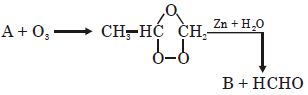
Here, $A$ and $B$ respectively are :-
During dischargning of lead storage cell concentration $H_2SO_4$ reduces from $40\%\ w/w$ to $30\% \ w/w$ . Find the total charged produced. Given volume of solution $4.9\ litre$ and density $= 1.2\ gm/ml$ ............ $\mathrm{faraday}$   [Assuming volume and density remain constant]
Which of the following is an amphoteric acid
Match the item given in Column I with expression given in Column II
Column IColumn II
(a) Osmotic Pressure$p = K _{ H } \cdot \chi_{ B }$
(b) Relative lowering of vapour pressure$\frac{\Delta P }{ P _A^o}=\chi_{ B }$
(c) Henry Law$\Delta T _{ b }= K _{ b } \cdot m$
(d) Elevation in boiling pointp = iCRT
In the following reactions products $(A)$ and $(B)$. respectively, are

$\mathrm{NaOH}+\mathrm{Cl}_{2} \rightarrow(\mathrm{A})+$ side products

(hot and conc.)

$\mathrm{Ca}(\mathrm{OH})_{2}+\mathrm{Cl}_{2} \rightarrow(\mathrm{B})+$ side products

$(dry)$

Amongst given elements, $+4$ oxidation state is known in aqueous medium for?
$2.33g$ of compound X(empirical formula $\mathrm{CoH}_{12} \mathrm{\sim N}_4 \mathrm{Cl}_3)$ upon treatment with excess $\ce{AgNO_3}$ solution produces $1.435g$ of a white precipitate. The primary and secondary valences of cobalt in compound $X,$ respectively, are. $[$Given $:$ Atomic mass$:\ \text{Co = 59, Cl = 35.5, Ag = 108].}$
If the rate constant for a first order reaction is $\mathrm{k}$, the time $(t)$ required for the completion of $99 \%$ of the reaction is given by
The unit $oh{m^{ - 1}}$ is used for