MCQ
$\mathop {\lim }\limits_{h \to 0} \frac{{\sqrt {x + h} - \sqrt x }}{h} = $
  • $\frac{1}{{2\sqrt x }}$
  • B
    $\frac{1}{{\sqrt x }}$
  • C
    $2\sqrt x $
  • D
    $\sqrt x $

Answer

Correct option: A.
$\frac{1}{{2\sqrt x }}$
a
(a) $\mathop {\lim }\limits_{h \to 0} \,\,\frac{{\sqrt {x + h} - \sqrt x }}{h} = \mathop {\lim }\limits_{h \to 0} \,\,\frac{{{{(\sqrt {x + h} )}^2} - {{(\sqrt x )}^2}}}{{h\,(\sqrt {x + h} + \sqrt x )}} = \frac{1}{{2\sqrt x }}$.

Aliter : Apply $L-$ Hospital rule,

$\mathop {\lim }\limits_{h \to 0} \,\,\frac{{\sqrt {x + h} - \sqrt x }}{h} = \mathop {\lim }\limits_{h \to 0} \,\,\frac{1}{{2\sqrt {x + h} }} = \frac{1}{{2\sqrt x }}$.

Need a full question paper?

Generate a complete, print-ready paper with questions like this in minutes — across 16+ boards, with answer keys.
Start Generating Free

Similar questions

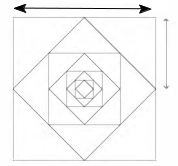
Let $S_1$ be the sum of areas of the squares whose sides are parallel to coordinate axes. Let $S_2$ be the sum of areas of the slanted squares as shown in the figure. Then, $\frac{S_1}{S_2}$ is equal to
The sum of the infinite series $\frac{1}{9} + \frac{1}{{18}} + \frac{1}{{30}} + \frac{1}{{45}} + \frac{1}{{63}} + ..........\infty$ is equal to :-
$\mathop {\lim }\limits_{x \to \infty } \,{\left( {\frac{{x + a}}{{x + b}}} \right)^{x + b}} = $
The tangents at the point $A (1,3)$ and $B (1,-1)$ on the parabola $y ^{2}-2 x -2 y =1$ meet at the point $P$. Then the area (in unit ${ }^{2}$ ) of the triangle $PAB$ is :-
Let $u=\frac{2 z+i}{z-k i}, z=x+i y$ and $k>0 .$ If the curve represented by $\operatorname{Re}( u )+\operatorname{Im}( u )=1$ intersects the $y$-axis at the points $P$ and $Q$ where $P Q=5,$ then the value of $k$ is 
From the point $A (0 , 3)$ on the circle $x^2 + 4x + (y - 3)^2 = 0$ a chord $AB$ is drawn $\&$ extended to a point $M$ such that $AM = 2\, AB$. The equation of the locus of $M$ is :
The tangent to the circle $C_1 : x^2 + y^2 - 2x- 1\, = 0$ at the point $(2, 1)$ cuts off a chord of length $4$ from a circle $C_2$ whose centre is $(3, - 2)$. The radius of $C_2$ is
Which of the following is not changed for the observations 31, 48, 50, 60, 25, 8, 3x, 26, 32? (where x lies between 10 and 15):
The number of solutions to the equation $\cos ^4 x+\frac{1}{\cos ^2 x}=\sin ^4 x+\frac{1}{\sin ^2 x}$ in the interval $[0,2 \pi]$ is
The straight line passing through the point of intersection of the straight lines $x - 3y + 1 = 0$ and $2x + 5y - 9 = 0$ and having infinite slope and at a distance of $2\, units$ from the origin, has the equation